Cybersecurity in 2026: Why Your Business Needs a Consultant, Not Just Software
by Sovina Vijaykumar
Your software firewall hums along, your endpoint agent shows green, and your dashboard reports zero critical alerts. Despite these safeguards, attackers can still find a way in.
Software alone cannot protect a business in 2026. However, while tools can detect threats, they cannot determine which risks matter most to your company. People make that call. A skilled information security consultant links technology to your revenue, your regulators, and your real exposure.
This post uses fresh data from IBM and Verizon. It shows how cybersecurity consulting turns scattered tools into a working defense.
The Numbers Behind the Risk
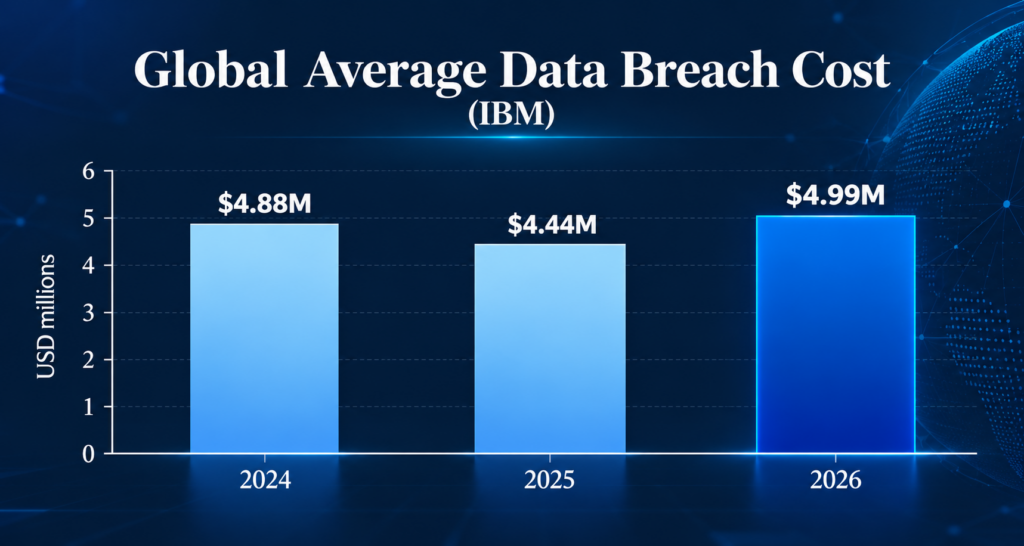
IBM’s 2026 Cost of a Data Breach Report set a new record. The global average breach now costs $4.99 million, up 12% from last year. U.S. organizations average $11.5 million per breach. Those figures should worry every executive, not just security teams.
Industry matters too. Healthcare remained the costliest sector for the 13th year, at $6.64 million per breach. Financial services followed at $6.29 million. Treat these averages as benchmarks, not predictions of your own loss.
Speed matters as much as price. The mean time to identify and contain a breach rose to 247 days, reversing five years of steady decline. Breaches lasting more than 200 days averaged $5.65 million, compared with $4.32 million for faster ones. Longer attacker access means a bigger bill.
Software buys you speed. A consultant buys you judgment. You need both.
Where Software Falls Short
Security tools do their jobs well. Their limits come from design, not defects. Consider three gaps.
1. Tools Lack Context
A scanner flags thousands of vulnerabilities. It cannot tell you which flaw threatens your payment system.
Verizon’s 2026 report shows the cost of that confusion. Organizations fully fixed only 26% of critical vulnerabilities in 2025, down from 38%. Exploited vulnerabilities now start 31% of breaches, making them the top entry point. A consultant ranks fixes by business impact. Your team then protects revenue-critical systems first.
2. Tools Ignore Your Vendors
Your suppliers hold your data, yet your software cannot audit their habits. Third-party involvement in breaches jumped 60% and now touches 48% of all incidents. Only 23% of those third parties fully fixed missing multifactor authentication on cloud accounts. A consultant reviews contracts, tests access, and demands proof.
3. Tools Do Not Govern AI
Employees adopt AI tools faster than security teams can approve them. IBM found that 92% of organizations with AI-related breaches lacked proper AI access controls. Verizon also reports shadow AI now ranks third among non-malicious insider actions. That share has grown fourfold. A consultant writes the policy, sets access rules, and trains staff to follow them.
A Hypothetical Breach, Step by Step
Picture a 200-person manufacturer with solid software. It runs endpoint protection, a firewall, and email filtering. Yet one supplier portal still uses a shared password without multifactor authentication.
An attacker buys that password from a criminal marketplace. The login looks normal, so no alert fires. Within days, the attacker reaches design files and customer records.
A consultant would have caught this gap during a vendor review. The fix takes an afternoon. The cleanup takes months. This scenario is hypothetical, but it mirrors the third-party failures Verizon documents. Tools watch systems, while consultants examine relationships.
AI Raises the Stakes
Attackers now use AI to scale their work. IBM reports that AI-driven attacks rose 56% and added about $1 million to the average breach cost. Roughly one in four malicious breaches now involves AI.
IBM lists phishing as the leading initial attack vector. Verizon found that humans played a role in 62% of breaches. Deepfake voices and flawless emails make employees easier targets.
Software filters many messages, but some still land. A consultant adds the human layer. This includes phishing simulations, payment verification rules, and clear escalation paths. Staff learn to pause before they click or wire money.
Three Myths That Weaken Security
Many leaders believe comforting stories. Three of them cause real damage.
• Myth: compliance equals security. Passing an audit proves you met a checklist. Attackers do not read checklists.
• Myth: we are too small to target. Attackers automate their searches. Weak credentials matter more than company size.
• Myth: our vendor handles everything. Vendors secure their products, not your configuration or your people.
What an Information Security Consultant Does
A good information security consultant does far more than run scans. The work falls into five areas.
• Asset mapping. The consultant finds every system, dataset, and vendor, including forgotten ones.
• Risk ranking. Cyber risk management ties each threat to a dollar figure and a business owner.
• Control testing. Penetration tests and tabletop exercises prove whether your defenses work.
• Compliance alignment. The consultant maps controls to HIPAA, PCI DSS, SOC 2, or state privacy laws.
• Executive translation. Boards want plain answers, not log files. A consultant delivers them.
Software vs. Consultant at a Glance
| Capability | Software | Consultant |
| Detects known threats | Yes | Supports |
| Ranks risk by business impact | No | Yes |
| Reviews vendor practices | Limited | Yes |
| Writes policy and governance | No | Yes |
| Briefs executives | No | Yes |
How Cybersecurity Consulting Builds Your Strategy
A strong business cybersecurity strategy follows a clear sequence. Consultants typically guide it in six steps.
1. Inventory everything. List assets, data flows, and third parties.
2. Quantify risk. Estimate the likely loss from each scenario.
3. Fix the basics first. Patch fast, enforce multifactor authentication, and test backups.
4. Rehearse your response. Run tabletop drills before a real crisis strikes.
5. Govern AI use. Approve tools, restrict data, and monitor access.
6. Review quarterly. Threats shift quickly, so your plan must shift too.
Verizon reaches a similar conclusion. It names asset visibility, disciplined patching, and practiced response plans as the foundations that work. Software supports each step. People must lead them.
Regulators Expect Proof, Not Promises
Law adds pressure to technology. All 50 U.S. states have their own breach notification laws. Public companies must disclose material incidents to the SEC within four business days of deciding an incident matters. IBM’s 2025 study found that 32% of breached organizations paid a regulatory fine.
A consultant builds the evidence trail regulators want. This includes risk assessments, policies, training records, and incident logs. Good documentation also speeds legal reviews after an incident.
Also read: https://katharosconsultancy.com/agentic-ai-consulting-firms-big-four-2026/
Smaller Companies Carry Big Exposure
Attackers do not skip small firms. Verizon found that small organizations had a median of seven credential leak events per year. Attackers favor easy targets, and a modest company with weak basics qualifies.
Most small businesses cannot afford a full-time chief information security officer. A consulting engagement or virtual CISO fills that gap affordably. You gain senior expertise without a senior payroll.
The news is not all bad. Verizon reports that 69% of ransomware victims refused to pay in 2025. Firms with tested backups and rehearsed plans can make that choice. Preparation, not luck, creates that option.
Software Plus Strategy Pays Off
Technology still matters. IBM found that extensive use of security AI and automation cut breach costs by $1.93 million. It also shortened breach lifecycles by 65 days. Yet only about one-third of organizations use these tools across the full security lifecycle. A consultant helps you choose, configure, and measure them. Your budget then buys outcomes, not shelfware.
What a First Engagement Looks Like
Engagements vary, but most follow a predictable path.
• Weeks one and two: discovery. The consultant interviews leaders, reviews tools, and maps assets.
• Weeks three and four: assessment. Testing and analysis expose gaps and rank risks.
• Week five: roadmap. You receive a prioritized plan with owners, costs, and deadlines.
• Ongoing: advisory. The consultant tracks progress, updates risks, and briefs your board.
Timelines depend on company size and complexity.
How to Choose the Right Consultant
Use this checklist during interviews:
• Start by checking credentials such as CISSP, CISM, or OSCP, and verify their relevance to the work.
• Industry experience can provide valuable context and insight into your specific challenges.
• Before hiring, make sure the engagement includes clear deliverables and realistic timelines.
• You can also assess the consultant’s track record by checking references from similarly sized clients.
• Another important consideration is confirming that the consultant is independent of software vendors.
• Most importantly, look for measurable outcomes, such as faster patching or shorter response times.
Conclusion
Cyber threats in 2026 move faster, hide inside vendors, and exploit AI gaps. Software remains essential, yet it cannot set priorities, manage suppliers, or brief your board. Cybersecurity consulting supplies the missing layer. It turns tools into a business cybersecurity strategy. It also gives cyber risk management a clear owner. Your customers trust you with their data, and a consultant helps you honor that trust.
Start small. Book an assessment, rank your top five risks, and fix the basics first. Then build from there. A single breach costs far more than a consultation.
Sources: IBM Cost of a Data Breach Report 2026 (and 2025); Verizon 2026 Data Breach Investigations Report.