Scaling AI Across the Enterprise: Lessons from McKinsey’s 2026 State of AI Survey
by Sovina Vijaykumar
Every boardroom now asks the same question. Where does the return on our AI spend show up? The latest McKinsey State of AI survey answers with good news and bad news.
The 2026 edition, titled “On the Road to ROI,” tracks how organizations adopt, scale, and profit from AI. Usage keeps rising. Profit impact has barely moved.
This post unpacks the data and translates it into practical moves. You will see what separates winners from laggards. You will also learn where leaders often stumble.
What the Survey Measured
McKinsey fielded the survey from May 4 to June 8, 2026, and collected 1,719 responses from 97 nations. The team weighted the data by each country’s contribution to global GDP.
Respondents span regions, industries, company sizes, and job functions. Thirty-six percent of them work at organizations above $1 billion in revenue. Large-company patterns therefore shape some of the averages.
Still, the numbers reflect what respondents attribute to AI. They do not prove that AI or any management practice caused a financial outcome. Treat self-reported data as a strong directional signal, not audited proof.
AI Adoption 2026: Scale Is Finally Arriving
The phrase AI adoption 2026 no longer describes scattered pilots. Forty-four percent of organizations now scale AI across the enterprise, up from 38% last year. Use in three or more functions rose from 51% to 56%. Roughly nine in ten organizations use AI regularly in at least one function.
Three patterns stand out:
- Tools have matured. Chatbots and coding agents now sit alongside agentic systems that act autonomously across workflows.
- Workers feel the benefit. Eighty percent say AI improved their individual productivity.
- Budgets keep growing. Most respondents expect their organizations to raise AI investment next year.
Rising budgets signal confidence. Confidence without measurement, however, invites waste.
Leaders now treat scaling AI enterprise programs as a core business goal, not a moonshot. Execution quality varies enormously. Some firms reap large gains. Others accumulate expensive experiments.
The Value Gap Nobody Can Ignore
Here the story turns. Only 37% of respondents attribute any EBIT impact to AI, unchanged from 2025. Productivity gains at the desk do not automatically reach the income statement.
Just 6% qualify as high performers, meaning they credit AI with at least 5% of EBIT. That share also stayed flat.
Consider the arithmetic. Most workers report saved time, yet only about a third of firms report profit. The savings leak somewhere. Leaders must find the leak.
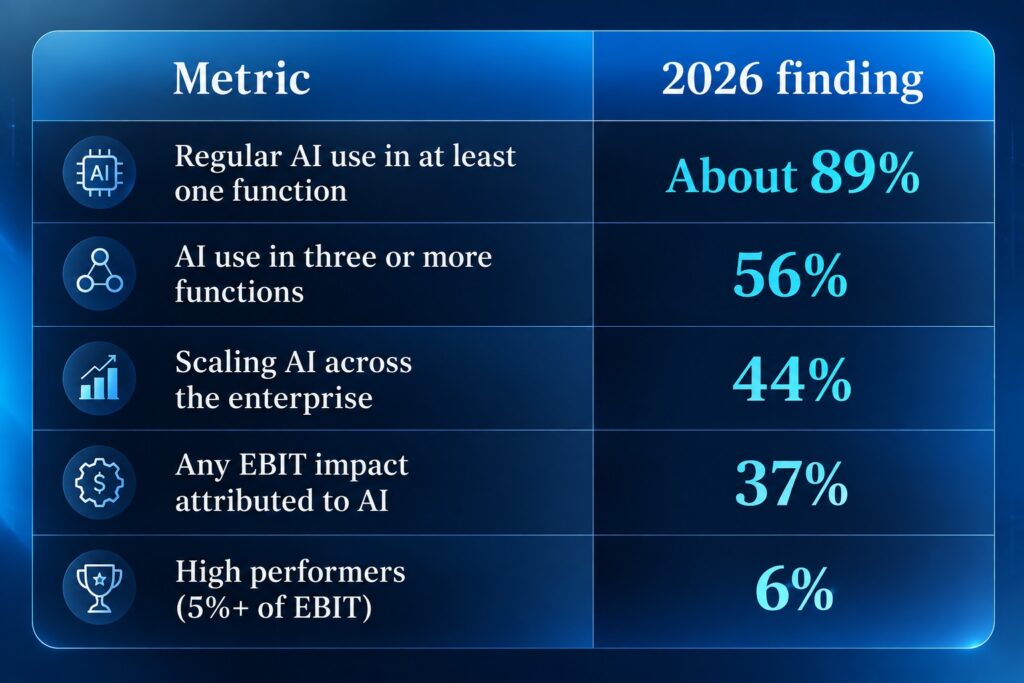
The funnel narrows sharply from usage to profit. Why does the gap persist? Consider three likely causes:
- Individual time savings dissolve into meetings, email, and extra tasks.
- Teams bolt AI onto old processes instead of rebuilding them.
- Leaders track usage metrics instead of business outcomes.
The survey cannot isolate one cause. It does show that adoption alone fails to guarantee profit.
What High Performers Do Differently
A small group of companies behaves differently. High performers differ from peers on investment, deployment, leadership, risk management, and workflow redesign. Each factor deserves a closer look.
Redesign workflows. Winners rebuild how work flows. They do not insert AI into existing steps. Imagine a claims team that reroutes cases so AI handles intake, triage, and first drafts. Humans then review only the exceptions. That design removes handoffs, where most delays hide.
Invest with purpose. The strongest programs fund data pipelines, integration work, and employee training alongside software licenses. Cheap pilots rarely survive contact with messy enterprise data.
Lead from the top. Senior executives own AI outcomes in these firms. They set targets tied to revenue and cost. They also review progress on a fixed cadence.
Manage risk actively. McKinsey’s separate trust research shows maturity improving. The average responsible AI maturity score reached 2.3 in 2026, up from 2.0. Stronger governance lets teams ship faster with fewer surprises.
Remember the caveat. The survey shows many differences, so it cannot isolate a single recipe. Still, the common thread is clear. High performers treat AI as an operating model change. They do not treat it as a software purchase.
Agents Move from Demo to Deployment
Agentic AI marks the next frontier. Forty percent of large organizations now scale agents in at least one function, up from 27%. Smaller organizations remain flat at 22%.
Size matters because agents demand clean data, engineering talent, and mature governance. Large firms simply hold more of those assets. Smaller firms can close the gap through partners and managed platforms.
Agents also change the build-versus-buy math. Nearly a third of firms skip some SaaS purchases because agentic coding tools let them build instead. Procurement teams should revisit vendor renewals with that option in mind.
Autonomy also raises the stakes. An agent that acts across workflows can create errors at machine speed. Build approval gates, audit logs, and rollback plans before launch.
The Hidden Constraint: Cost and Headcount
Money now shapes AI strategy. About 20% of respondents say operating costs, including token fees, have led some organizations to limit AI use. The issue grows even more pronounced among high performers.
Headcount raises a second concern. Thirty-nine percent of respondents expect AI to reduce overall headcount over the next year. Forty-three percent expect no AI-related change. Last year’s forecasts also missed the mark. The share expecting declines was about double the share reporting actual declines.
One analyst flags a trap. If firms cut staff expecting AI to absorb work, cost limits could later cap AI use, and demand could outpace capacity. Delivery would then suffer.
The fix is simple in principle. Plan headcount, compute budgets, and service levels together. Do not let finance and technology teams forecast in isolation.
A Practical Playbook for Leaders
An enterprise AI strategy consultant would likely turn these findings into five moves. Use them as a checklist.
- Pick outcomes first. Tie every use case to an EBIT, revenue, or cycle-time target.
- Redesign before deploying. Map the workflow, remove steps, and then place AI where it adds leverage.
- Build shared platforms. Common data, security, and evaluation tools reduce duplicate work across teams.
- Govern early. Define risk owners, testing standards, and escalation paths before agents touch customers.
- Model total cost. Track tokens, integration, and change management against measured gains.
When should you hire outside help? Consider an enterprise AI strategy consultant when internal teams lack cross-functional authority. Outsiders can benchmark peers, challenge assumptions, and speed decisions. They also carry lessons from many rollouts.
How to Measure Progress
Leaders often ask which numbers to watch. Start with a short scorecard. Review it every quarter.
- Workflow coverage: the share of core processes redesigned, not merely assisted.
- Financial attribution: the EBIT or revenue effect that finance teams have validated.
- Cost per outcome: total AI spend divided by completed units of work.
- Adoption depth: the number of functions using AI beyond basic chat.
- Risk incidents: frequency, severity, and time to resolve.
Finance must co-own these metrics. Otherwise, technology teams will report usage while executives ask about profit. Shared ownership ends that mismatch early.
Common Mistakes to Avoid
Even strong teams stumble. Watch for these traps:
- Chasing tools. New models launch constantly. Strategy should outlast any single vendor.
- Skipping change management. Employees need training, incentives, and clear role definitions.
- Scaling too early. Prove value in one workflow before copying it across the company.
- Ignoring data quality. Agents amplify bad inputs rapidly.
Each mistake traces back to one root cause. Teams focus on technology and forget the organization.
Final Takeaway
The McKinsey findings deliver one clear lesson. Access to AI no longer differentiates companies. Redesign, ownership, and discipline do.
Leaders who treat AI as a workflow transformation will pull ahead. Those who treat it as a tool rollout will keep collecting productivity anecdotes and flat profit.
Try this 90-day plan:
- Choose one high-value workflow and assign an executive owner.
- Redesign it end to end, then pilot it with clear financial targets.
- Measure results with finance, and share them internally.
- Scale what works, and retire what does not.
The road to ROI exists. Companies must walk it deliberately.