Change Management in 2026: The Prosci Model and What’s Evolved
by Sovina Vijaykumar
Why Technology Alone Never Delivers
Most leaders have lived through a failed rollout. The software worked. The plan looked sound. Yet employees ignored the new process and slid back to old habits.
That gap defines change management in 2026. Tools now arrive faster than teams can absorb them. AI, automation, and hybrid work all land at once.
Leaders need a people-first method. This post explains the Prosci methodology, shows what has shifted, and offers a practical path forward.
A 2025 trends report from OCM Solution notes that only about one-quarter of corporate transformations deliver enduring results. The cause rarely lies in the code. It lies in how people adopt the change.
What the Prosci Methodology Includes
Prosci has studied change for more than 25 years. Its 12th edition benchmarking study draws on responses from more than 10,800 professionals worldwide. Prosci calls it the largest body of change research in the industry.
The Prosci methodology rests on three connected tools. Each tool answers a different question.
ADKAR: The Individual Lens
ADKAR tracks one person through a change. The letters stand for Awareness, Desire, Knowledge, Ability, and Reinforcement.
The order matters. A manager cannot build skills in someone who does not yet want the change. Practitioners identify the first weak element and address it.
The 3-Phase Process: The Project Lens
This process organizes the work into three stages:
- Prepare Approach: Assess the change and plan the strategy.
- Manage Change: Carry out the plans and adjust as resistance appears.
- Sustain Outcomes: Measure results and lock in new behaviors.
The PCT Model: The Success Lens
The Project Change Triangle links three forces: leadership and sponsorship, project management, and change management. Success depends on all three. Weakness in any corner pulls the result off balance.
The Evidence for a Structured Approach
Why should executives care? Prosci research, cited in a 2025 United Nations study, offers a clear answer. Organizations that apply best practices gain a measurable edge on three fronts.
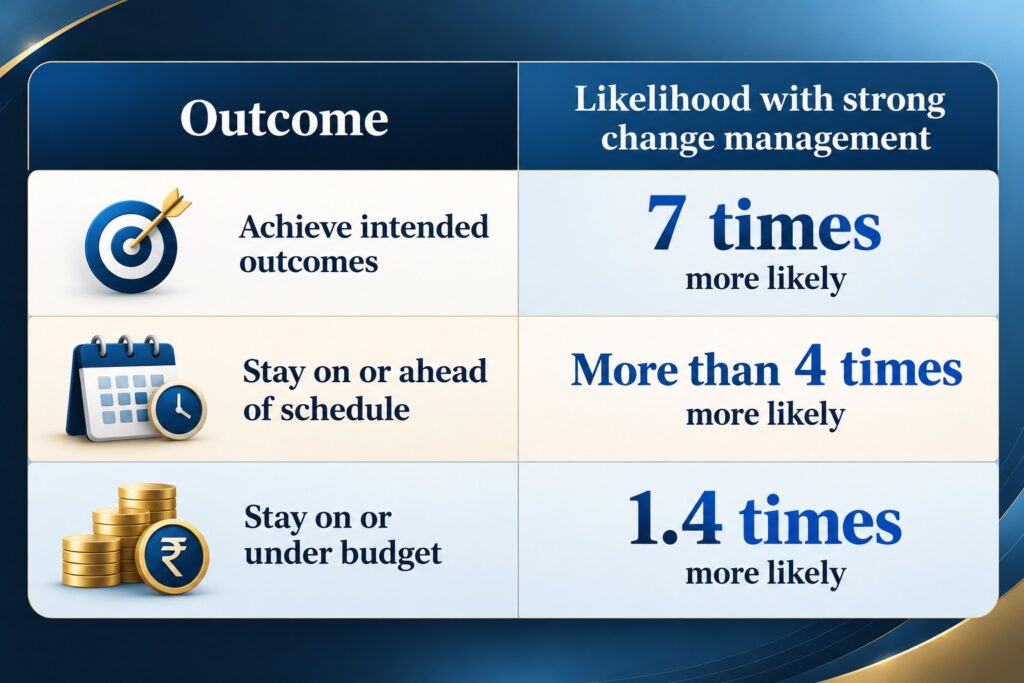
These multipliers build a strong business case. Cite them when budget conversations begin.
What Has Evolved by 2026
The core model still holds. The surrounding practice has changed in five clear ways.
1. Frontline Voices Carry More Weight
In Prosci’s latest edition, engaging frontline employees ranks third among the top best practices. Frequent, open communication slipped to fourth place.
Frontline employees live with the change daily. They spot process gaps that planners miss. Involve them early to improve design and buy-in.
Practitioners also battle the myth that change management means only communication. Listening now counts as much as announcing.
2. Research Became Personal
Prosci’s new interactive report lets users filter benchmarks by industry, organization size, and annual revenue. Practitioners now compare their own situation against true peers instead of one global average.
3. AI Is Both Subject and Tool
AI creates change, and AI supports change work. The OCM Solution report names AI literacy the most in-demand skill for change professionals in 2025.
A 2025 United Nations survey found that 31 percent of respondents use AI tools regularly in change management. Prosci also runs webinars on applying ADKAR to AI adoption challenges.
4. Change Became Continuous
The United Nations report describes change as continuous, dynamic, urgent, and complex. One initiative rarely arrives alone.
Leading teams increasingly use change portfolio management. It shows every active and upcoming initiative in one view. Leaders can then spot overload before it harms morale.
5. Sponsors Face Higher Expectations
The United Nations findings urge sponsors to champion change management as a strategic enabler. Sponsors should also set clear expectations and invest in capability.
The OCM Solution report also stresses active, visible executive sponsorship.
Example: Applying ADKAR to an AI Rollout
Picture a finance team adopting an AI forecasting tool. Here is how ADKAR guides the work.
- Awareness: Explain why manual forecasting no longer meets business needs.
- Desire: Show analysts how the tool removes tedious work, not their jobs.
- Knowledge: Teach prompt writing, data checks, and error spotting.
- Ability: Give analysts sandbox time with real data and coaching.
- Reinforcement: Recognize early adopters and share their time savings.
Notice the order. If analysts feel threatened, training alone will fail. Desire must come before Knowledge.
This scenario is hypothetical, yet it mirrors common adoption barriers.
Building a Change Management Framework That Works
A strong change management framework turns research into routine. Follow these six steps.
Step 1: Pick One Method
Choose a single approach and train every project lead in it. The United Nations report suggests standardized practices could build maturity and agility. Consistency helps teams compare results across initiatives.
Step 2: Embed Change in the Project Plan
Add change activities to the project schedule. Train the project team in basic change skills. Prosci research supports both actions.
Step 3: Assess Readiness by Group
A sales team and a warehouse crew face different barriers. Run an ADKAR assessment for each group. Then tailor your plans to match.
Step 4: Use AI With Guardrails
Let AI draft messages, summarize feedback, and flag patterns in survey data. Keep humans in charge of judgment, trust, and tone. Review every output before it reaches employees.
Step 5: Measure Adoption, Not Delivery
A go-live date proves nothing about behavior. Track usage, proficiency, and sentiment instead. These metrics reveal whether the change is taking hold.
Step 6: Reinforce After Launch
Celebrate early wins and fix friction quickly. Check in at 30, 90, and 180 days. Reinforcement is the final letter in ADKAR for a reason.
Metrics That Show Real Progress
Track both leading and lagging indicators. Together, they show whether people are changing.
- Leading indicators: training attendance, sponsor visibility, and readiness survey scores.
- Lagging indicators: adoption rate, proficiency levels, and realized benefits.
Review the numbers monthly with your steering committee. Adjust plans when the data shows stalled adoption.
When Organizational Change Consulting Makes Sense
Not every team needs outside help. Some situations do.
Organizational change consulting adds the most value in these cases:
- The initiative spans several regions or business units.
- Internal leaders lack the time to manage the people side.
- A previous change effort failed, and trust is low.
- Executives need coaching on their sponsor role.
- A regulator or customer demands documented results.
Choose a partner carefully. Look for certified practitioners who use a proven change management framework. Ask how they measure adoption. Ask how they will transfer skills to your staff.
Good consultants make themselves unnecessary. They train your people, hand over tools, and leave lasting capability behind. Beware of firms that sell only slide decks.
Mistakes to Avoid in 2026
Even experienced teams repeat these errors:
- Treating change as a messaging task. Communication matters, but it covers only one slice of the work.
- Launching without a visible sponsor. Employees watch leaders closely and copy what they see.
- Ignoring change fatigue. Stacked initiatives drain energy, so sequence them with care.
- Declaring victory at go-live. Adoption takes months, not days.
- Letting AI replace conversations. Automation can scale messages, but it cannot build trust.
How to Read the Research With Care
Benchmarks guide decisions, but context matters. Keep three cautions in mind.
- Self-reported surveys reflect practitioner views, not controlled experiments.
- Vendor research may favor its own methodology.
- Your industry, culture, and scale may differ from the sample.
Use the numbers as a starting point. Then test them against your own data.
Looking Ahead: Where the Discipline Goes Next
Expect three shifts over the next few years.
- Personalized benchmarks will replace one-size-fits-all averages.
- AI literacy will become a baseline skill for every change practitioner.
- Portfolio thinking will move from large enterprises to mid-sized firms.
Digital-first engagement will matter too. The OCM Solution report says successful change now requires digital-first engagement and asynchronous communication for distributed teams.
The Bottom Line
Change management in 2026 demands more of leaders than in any earlier era. Technology moves quickly, and people need time, clarity, and support.
The Prosci methodology still offers a reliable backbone. ADKAR guides individuals, the 3-Phase Process guides projects, and the PCT Model guides leaders.
What has evolved is the practice around it. Frontline voices, personalized data, AI, and portfolio thinking now shape results.
Start small. Pick one initiative, apply a structured change management framework, and measure adoption. Then build from there. Your people will notice the difference.
Sources
- Prosci, Best Practices in Change Management, 12th Edition (prosci.com)
- UN System, State of Change Management 2025 (socm.unssc.org)
- OCM Solution, 2025–2026 Organizational Change Management Trends Report