How to Align Leadership Teams for Faster Execution
by Sovina Vijaykumar
Most organizations don’t fail from a shortage of ideas or talent. They fail because the people at the top are quietly pulling in different directions, and nobody is willing to name it.
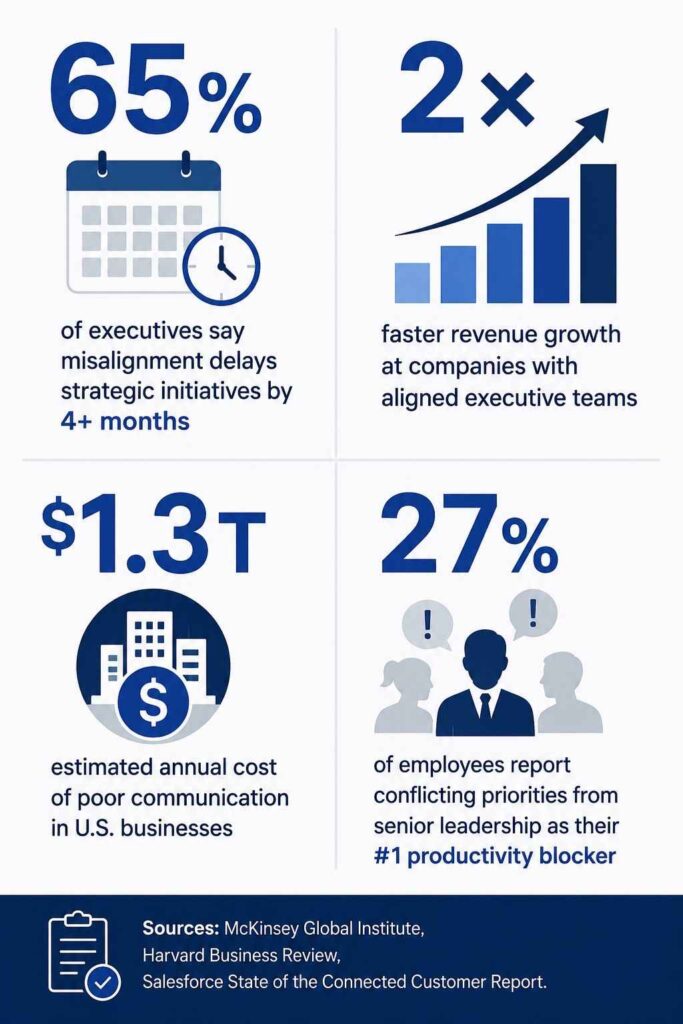
Every quarter, organizations pour resources into strategic planning, retreats, consultants, cascading OKRs, and carefully formatted slide decks. Yet the intended outcomes rarely arrive on schedule. Teams blame missed deadlines on market conditions, resource gaps, or front-line execution breakdowns. The real culprit, more often than not, sits within the C-suite itself: leadership alignment, or, more precisely, its absence.
When an executive team doesn’t share a common understanding of priorities, decision rights, and the trade-offs they’re willing to accept, the effects cascade downward rapidly. Middle managers receive mixed signals and hedge their bets. Project teams feel competing pulls from different parts of the business. Decisions that should take a week take three months. Momentum collapses under the weight of perpetual recalibration.
This piece examines how organizations can close the alignment gap, not through better meeting structures or culture retreats, but through a deliberate, technology-informed approach to how leadership teams operate, communicate, and decide.
The Alignment Gap Is Wider Than Most Leaders Realize
Leadership teams commonly overestimate their own alignment. In a study by MIT Sloan Management Review, senior leaders rated their team’s strategic alignment at an average of 7.2 out of 10. When researchers independently assessed the same teams, the actual alignment score averaged 4.8. That 2.4-point gap is not a rounding error; it represents a structural blind spot baked into how most leadership teams function.
Part of the problem is definitional. Leaders frequently align on language without aligning on meaning. When everyone in a room nods at the phrase “customer-first growth,” they don’t necessarily picture the same trade-offs. Does customer-first mean prioritizing service recovery over new feature development? Should it involve accepting lower short-term margins to build loyalty? Or does it require channeling engineering resources toward UX improvements rather than back-end infrastructure? Without explicit answers to these questions, each executive applies their own interpretation and executes accordingly.
“The bottleneck is rarely the strategy itself. It’s the gap between what leaders say they agreed on and what they each actually heard.”
— Roger Martin, Former Dean, Rotman School of Management
Modern executive team strategy must treat alignment not as a static outcome from a single planning session, but as a dynamic capability that organizations build, test, and maintain in real time. This reframing has significant implications for how leadership teams invest their time and attention.
Why Traditional Alignment Methods Fall Short
Most organizations default to two alignment mechanisms: off-site strategy retreats and executive committee meetings. Both have value. Neither is sufficient.
Strategy retreats offer a concentrated window of shared focus but suffer from a fundamental shelf-life problem. A McKinsey study found that more than 70% of strategic decisions made at off-site retreats undergo significant revision within 90 days of return to normal operations. Context shifts, competing priorities emerge, and the cross-functional clarity from a two-day retreat dissipates inside the organizational complexity of daily work.
Executive committee meetings, meanwhile, tend to favor reporting over deciding. Agendas fill with operational updates, and the hard conversations about resource conflicts, strategic trade-offs, and accountability rarely get enough structured time. When difficult topics do arise, they often surface too late or without the analytical underpinning needed for real resolution.
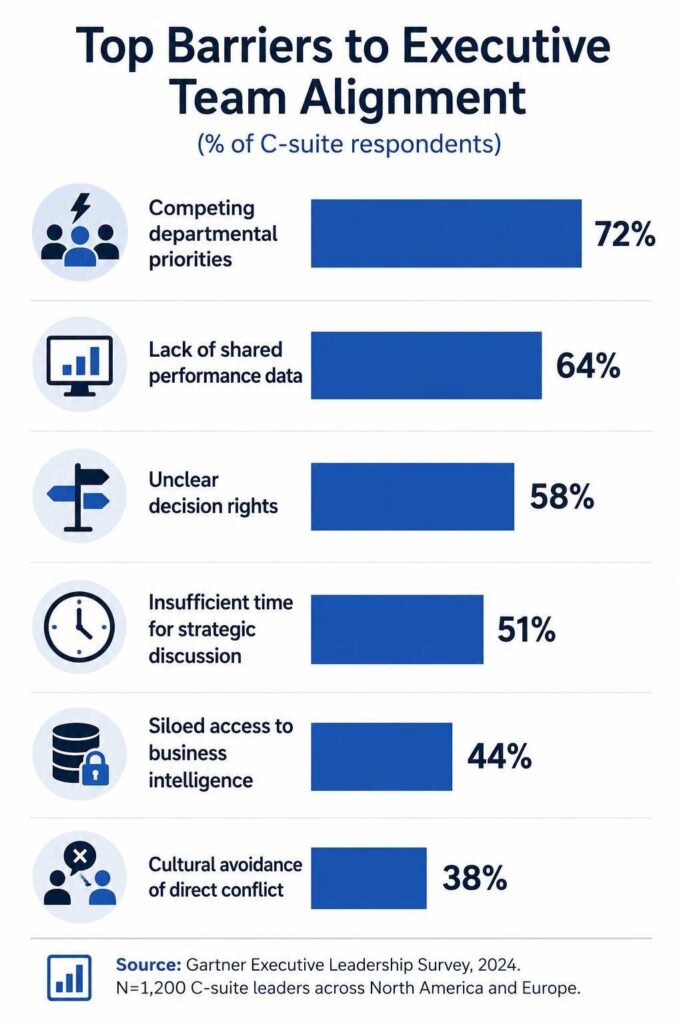
The data reinforces what practitioners in business execution consulting have long observed: a single factor rarely causes alignment problems. They stem from an overlapping set of structural and behavioral dynamics that conventional governance models don’t adequately address.
A Technology-Informed Framework for Leadership Alignment
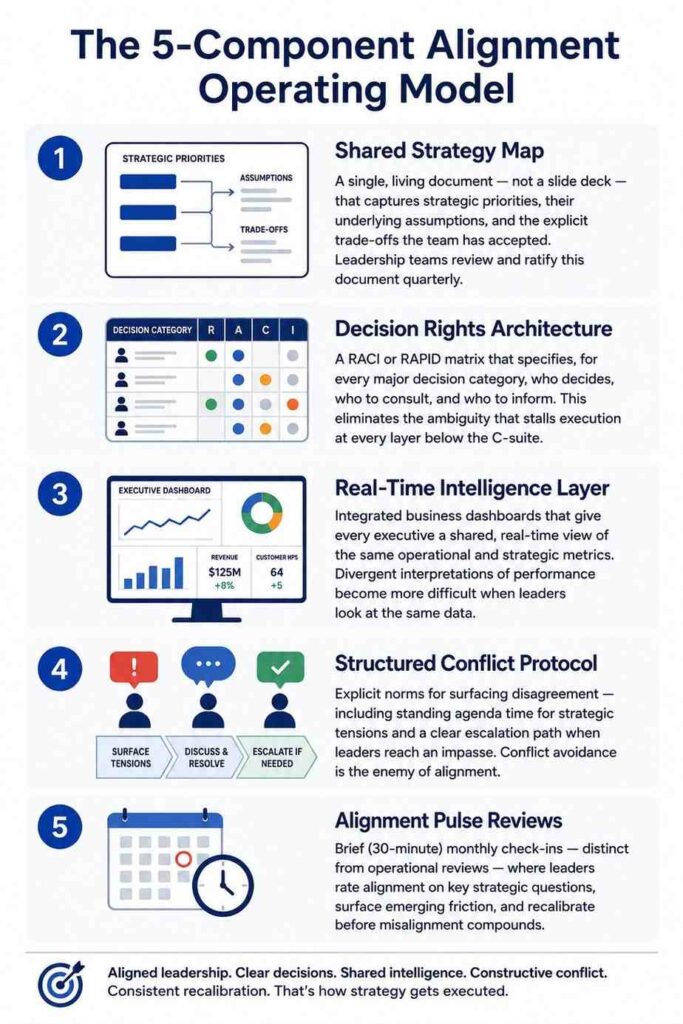
Closing the alignment gap requires a deliberate operating model, one that combines behavioral discipline with the data infrastructure to make alignment visible, measurable, and self-correcting. Below is a five-component framework that high-performing leadership teams apply consistently.
The Role of Technology in Sustaining Alignment
Technology doesn’t create leadership alignment. But it removes the informational conditions that allow misalignment to persist invisibly. Three categories of technology have proven particularly consequential.
Enterprise performance platforms, such as Workday Adaptive Planning, Anaplan, and IBM Planning Analytics, give executive teams a unified view of financial, operational, and strategic data. When every leader sees the same numbers in the same format, conversations shift from debating reality to debating response. That is a meaningfully faster starting point for any strategic discussion.
AI-assisted decision support represents a newer but rapidly maturing capability. Tools like Microsoft Copilot for Finance and emerging purpose-built leadership intelligence platforms now synthesize cross-functional data to surface misalignments before they manifest in execution failures. Some organizations use these tools to run automated “strategy consistency checks”, essentially asking the AI to identify when near-term resource allocation decisions conflict with stated long-term priorities. The output is not a recommendation but a flag, a trigger for a leadership conversation that might not have happened otherwise.
Asynchronous collaboration infrastructure matters more than most leadership teams acknowledge. When executives operate across multiple time zones or heavily fragmented calendars, synchronous alignment becomes a bottleneck. Platforms like Loom, Notion, and enterprise-grade knowledge management systems allow leadership to document decisions, share context, and maintain a living record of strategic agreements, reducing the drift that accumulates between formal meetings.
“The best executive teams don’t just align once a quarter at the off-site. They build systems that make alignment the path of least resistance every single week.”
— Amy Edmondson, Novartis Professor, Harvard Business School
What Aligned Leadership Teams Do Differently
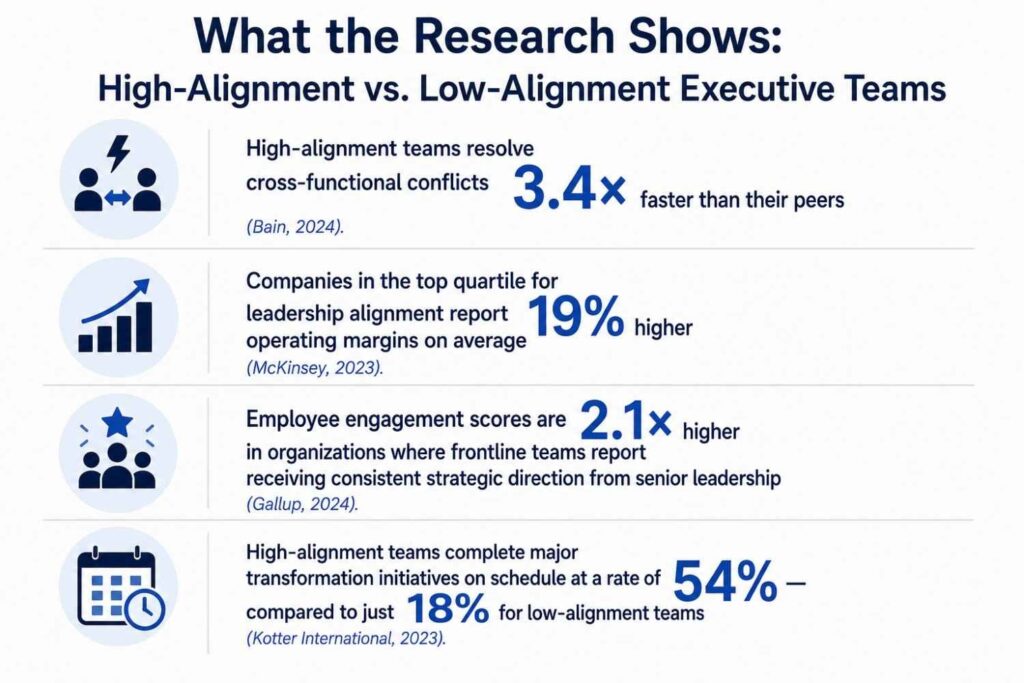
Research from Bain & Company’s 2024 CEO survey of 500 global companies identified a cluster of behaviors that statistically distinguish high-alignment executive teams from their peers. These teams don’t operate through consensus; they operate through clarity. They accept that disagreement will occur and build governance structures that channel disagreement toward resolution rather than avoidance.
High-alignment teams also invest explicitly in what researchers call “strategic coherence reviews”, regular sessions where executives stress-test current initiatives against the organization’s stated priorities. When a new initiative doesn’t map cleanly to a strategic priority, the team either rejects it, modifies the initiative, or updates the priority. They don’t allow the strategic roadmap and the operational reality to drift apart silently.
Building Alignment as an Organizational Capability
Practitioners in business execution consulting increasingly distinguish between organizations that treat alignment as an event and those that treat it as a capability. The event-based approach to the annual strategy retreat, the quarterly planning cycle, produces alignment in bursts, followed by gradual entropy. The capability-based approach embeds alignment into the organization’s operating rhythm, making it continuous rather than periodic.
Building that capability requires simultaneous investment in three areas. Leadership teams must invest in behavioral norms, the explicit agreements about how they communicate, surface conflict, and hold each other accountable. They must invest in data infrastructure to ensure that the information inputs to leadership decisions are shared, timely, and trustworthy. And they must invest in governance design, the structures that determine who decides what, at what speed, and with what information.
None of these investments is exotic. Most organizations already have some version of each. The gap is typically in integration: behavioral norms that operate independently of data infrastructure, governance structures that don’t connect to strategic priorities, and planning cycles that treat alignment as an input rather than an ongoing output.
The competitive advantage available to organizations that close this gap is not marginal. According to research published in the MIT Sloan Management Review, companies that achieve and sustain strong leadership alignment execute strategic initiatives at nearly double the speed of those that don’t without adding headcount, capital, or complexity. They don’t move faster because they work harder. They move faster because they stop losing time to internal friction that should never have existed in the first place.
The Practical Starting Point
For most executive teams, the most valuable first step is not a technology implementation or a governance redesign. It is a structured conversation, facilitated by someone outside the team’s political dynamics, that surfaces the misalignments everyone senses, but no one has named. A skilled facilitator with experience in executive team strategy and organizational behavior can safely surface these tensions, translate them into structural solutions, and help the team build the habits that make alignment self-sustaining.
The organizations that execute fastest are not necessarily those with the best strategy. They are those whose leadership teams have learned to move as a coherent unit, disagreeing openly, deciding quickly, and communicating their decisions with the clarity that allows execution to proceed without constant re-interpretation at every organizational level below them.
That kind of coherence doesn’t happen by accident. It happens by design. And it starts at the top.