Digital Transformation Beyond Buzzwords: What Actually Works
by Sovina Vijaykumar

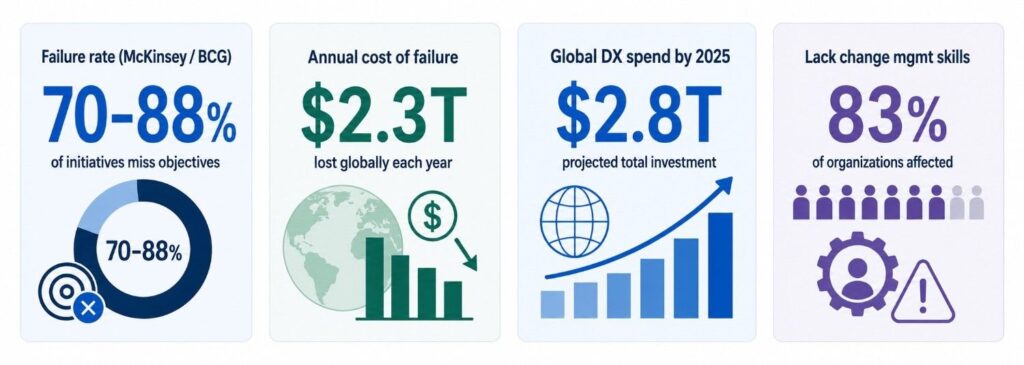
Every boardroom conversation in the past decade has circled back to the same phrase: digital transformation. Executives repeat it in earnings calls. Consultants build entire service lines around it. And yet, the results remain stubbornly disappointing. According to research from McKinsey and Boston Consulting Group, 70% of digital transformation initiatives fail to meet their stated objectives. Bain’s 2024 analysis pushes that number even higher, finding that 88% of business transformations fall short of their original ambitions. Collectively, these failed initiatives drain an estimated $2.3 trillion from global organizations every year.
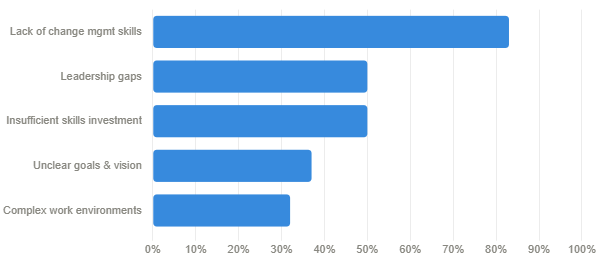
Top root causes of digital transformation project failure
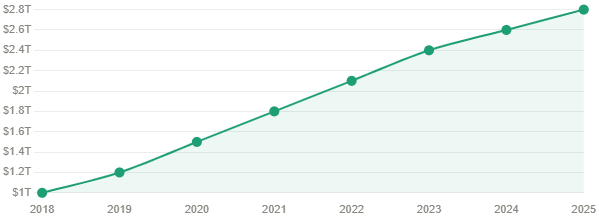
The paradox is real: companies spend more on transformation than ever before. Global digital transformation spending will hit $2.8 trillion by 2025, yet the gap between investment and outcome only widens. Understanding why that gap exists, and more importantly, how the organizations that beat the odds actually operate, requires stepping back from the noise and examining what the data and practitioners on the ground consistently confirm.
The Buzzword Problem Is Also a Strategy Problem
When organizations treat digital transformation as a destination rather than a continuous operating model, they design for the wrong outcome. They invest heavily in technology procurement, cloud platforms, AI tools, ERP systems, and then measure success by go-live dates rather than sustained behavioral or financial change. The result is an expensive collection of underused tools and a workforce that reverts to old patterns within months.
The core issue, in most cases, is not technology. It is the absence of a coherent digital transformation strategy that ties technology investments to specific, measurable business outcomes. A lack of clear goals and vision accounts for 37% of project failures, according to recent industry analysis. Another 32% of leaders identify complex work environments as a major structural barrier. When every initiative carries “strategic priority” status, none of them receives the focused execution they require.
A sound digital transformation strategy does not begin with a shortlist of platforms. It begins with an honest diagnosis of where value is created and destroyed in the current operating model, then works backward to identify which technology capabilities can close that gap. This sequencing matters enormously. Organizations that reverse the order, selecting tools first and then searching for problems those tools might solve, consistently report higher failure rates and lower returns on investment.
What Business Transformation Consulting Gets Right (and Often Misses)
The business transformation consulting industry has matured significantly over the past decade. The best practitioners no longer sell technology implementation alone. They frame engagements around capability building, change management, and organizational design, recognizing that a company can deploy the most sophisticated platform in its industry and still see negligible impact if the surrounding structure and culture remain unchanged.
However, consulting engagements frequently fall short in the handoff. Many projects deliver impressive blueprints and well-structured roadmaps, then exit before the hard work of embedding new ways of working into daily operations begins. Roughly 83% of organizations report a lack of employees with the change management skills needed to sustain transformation initiatives after external support withdraws. That statistic reflects a systemic failure in how engagements are scoped and closed.
The consulting firms and internal transformation teams that consistently outperform their peers share a specific characteristic: they treat adoption as a first-class deliverable, not an afterthought. Before any technology goes live, they invest in understanding how frontline workers actually use the current system, what informal workarounds exist, and what incentive structures drive behavior. That intelligence shapes everything from interface design to training cadence to the way teams redefine performance metrics.
The Tech Adoption Strategy Gap
Even organizations with well-developed strategies and capable consulting partners frequently underestimate the complexity of a durable tech adoption strategy. Adoption is not a training event. It is not a communication plan distributed two weeks before launch. It is a sustained, iterative process that requires measurement, feedback loops, and genuine executive accountability.
The data bears this out. By early 2024, roughly 40% of enterprise applications had embedded conversational AI specifically to assist users in real time, a direct response to the recognition that traditional training methods are insufficient for complex software environments. In-app guidance, contextual prompts, and AI-assisted support have become infrastructure-level requirements, not nice-to-have features, for any organization serious about reducing time-to-proficiency.
Consider what a well-designed tech adoption strategy actually looks like in practice. It identifies specific user cohorts, not just “employees” as an undifferentiated group, and maps each cohort’s current workflow against the desired future state. Before rollout, teams establish baseline metrics: how long does a current process take, what is the error rate, and how often do users seek help? After deployment, the organization tracks those same metrics week by week and uses deviations as early warning signals rather than lagging indicators discovered in a quarterly review.
Organizations that build adoption infrastructure this way report meaningfully different outcomes. They catch resistance before it solidifies into entrenchment. They identify which user segments need additional support before those segments become organizational blockers. And they create a feedback mechanism that continuously improves the platform configuration based on actual usage data rather than assumptions made at the design stage.
The Four Patterns That Separate Transformations That Work
Across industries and geographies, the organizations that successfully execute digital transformation tend to share four structural patterns, none of which involve any specific technology vendor or platform category.
1. Executive accountability with operational specificity. Successful transformations attach named executives to specific outcome metrics rather than broad themes. “Improve customer experience” is not accountable. “Reduce average service resolution time from 4.2 days to 1.8 days by Q3.” The specificity forces honest conversations about resourcing and creates the conditions for early course correction.
2. Modular roadmaps over comprehensive overhauls. The instinct to transform everything simultaneously is understandable but consistently counterproductive. Organizations that sequence transformation into discrete, value-generating modules, each one delivering measurable improvement before the next begins, maintain higher adoption rates, lower abandonment rates, and more sustainable momentum. They also build institutional knowledge progressively rather than overwhelming the organization at once.
3. Change management as a parallel workstream, not a phase. The most common structural mistake in transformation programs is treating change management as something that happens after leaders make technology decisions. High-performing organizations integrate change management from the earliest stages of strategy development. By the time a platform goes live, affected employees participate in design decisions, practice on sandboxed environments, and understand specifically how their roles and performance metrics will shift.
4. Data infrastructure before analytics ambition. Organizations frequently invest in advanced analytics capabilities, machine learning models, predictive dashboards, and AI-driven insights before establishing the data quality and governance foundations those capabilities require. The result is an impressive-looking infrastructure that produces unreliable outputs, erodes trust, and eventually gets abandoned. The organizations that avoid this pattern invest in data stewardship, taxonomy standardization, and pipeline reliability before building the analytical layer on top of them.
The Realistic Picture for 2026 and Beyond
Digital transformation spending continues to accelerate despite persistently high failure rates, which tells us something important. Organizations recognize that the cost of not transforming exceeds the cost of failed attempts. Competitive pressure, shifts in customer expectations, and workforce dynamics all require continuous technological adaptation. The question is no longer whether to pursue transformation, but whether to do so with the strategic discipline and organizational infrastructure that give it a realistic chance of delivering on its promise.
Global digital transformation spending ($ trillion), 2018–2025
The organizations that will pull ahead over the next three to five years are not necessarily those with the largest technology budgets. They are the ones that treat transformation as an ongoing operating model, continuously assessing, deploying, measuring, and refining rather than a discrete program with a start and an end date. They invest as seriously in the human architecture of transformation as they do in the technical infrastructure. And they hold their digital transformation strategy, their consulting partnerships, and their tech adoption strategy to the same standard they apply to every other strategic investment: a demonstrable, sustained return on capital deployed.
The buzzwords will continue to evolve. The fundamentals will not.
Data sources: McKinsey & Company, Boston Consulting Group, Bain & Company (2024), Gartner, IDC Worldwide Digital Transformation Spending Guide.