AI-Powered Scenario Planning: How Consultants Are Forecasting Smarter in 2026
by Sovina Vijaykumar
Consulting firms built their reputation on foresight. Clients paid for judgment, not just data. That model is shifting fast in 2026.
Uncertainty has become the new normal in business. Supply chains break without warning. Regulations change overnight. Markets swing on a single headline. Old forecasting methods cannot keep pace with this speed.
AI scenario planning fills that gap. Consultants now build multiple futures at once, instead of guessing one outcome. They test each scenario against live data streams. The result is a sharper, faster, and more defensible strategy.
This shift is not a minor tool upgrade. It is changing how consulting firms think, price, and deliver work.
Why Traditional Forecasting Fell Behind
For decades, forecasting relied on static spreadsheets and annual planning cycles. Analysts built one base case, then adjusted it slightly for optimism or pessimism.
That approach worked when change moved slowly. It breaks down when disruption arrives weekly.
A recent PwC global survey found that many CEOs feel they are deciding unthinkingly. They lack realistic pictures of what might happen next. That admission from top executives says a lot about the limits of legacy planning.
Static models also struggle with combined risks. A single spreadsheet cannot easily show how currency shifts, tariffs, and labor shortages interact together. Consultants needed a method built for complexity, not simplicity.
Three Core Weaknesses of Legacy Planning
- Slow refresh cycles. Annual plans go stale within months.
- Single-path thinking. One forecast hides real uncertainty.
- Manual bottlenecks. Analysts spend weeks building models by hand.
These weaknesses created an opening. AI filled it quickly, and consultants noticed the difference right away.
What AI Scenario Planning Actually Means
AI scenario planning uses machine learning to generate many possible futures at once. Each scenario reflects a different mix of assumptions. Instead of one forecast, leaders see a range of plausible outcomes.
This differs sharply from older simulation tools. Legacy simulations needed heavy manual setup. Today’s systems adjust variables automatically as new data arrives.
Consultants feed these models with economic indicators, competitor moves, and internal performance data. The AI then stress-tests strategy against dozens of shifting conditions.
How the Process Works in Practice
- Define the core business question or decision.
- Feed historical and real-time data into the model.
- Generate multiple scenarios with varying assumptions.
- Rank scenarios by probability and potential impact.
- Translate results into clear recommendations for clients.
Each step used to take analysts days. AI compresses that timeline into hours, sometimes minutes.
AI-Driven Forecasting Enters the Mainstream
AI-driven forecasting is no longer an experimental add-on inside consulting firms. Recent industry data shows adoption accelerating sharply across the sector.
According to Deloitte’s 2026 State of AI in the Enterprise report, consulting clients now fall into roughly three groups. About a third are deep transformers rebuilding processes around AI. Another third are redesigning workflows for efficiency gains. The remaining third still use AI only as a surface tool.
Firms in that first group report the strongest returns. Deloitte’s survey found that 66 percent of adopting organizations see measurable productivity gains. Just over half report better overall decision-making quality.
Separately, Source Global Research found a major mindset shift among UK consulting buyers. Clients describing themselves as cautious about generative AI dropped from half in 2025 to less than a quarter in 2026. Meanwhile, eager adopters more than doubled in the same period.
Survey Snapshot: AI Adoption in Consulting (2026)
| Metric | Share Reporting |
| Firms citing measurable productivity gains from AI | 66% |
| Firms citing better decision-making from AI | 53% |
| Firms citing cost reduction from AI | 40% |
| Firms citing improved client relationships from AI | 38% |
| Buyers now eager to deploy generative AI (up from 15%) | 40%+ |
Sources: Deloitte State of AI in the Enterprise (2026); Source Global Research UK survey (2026).
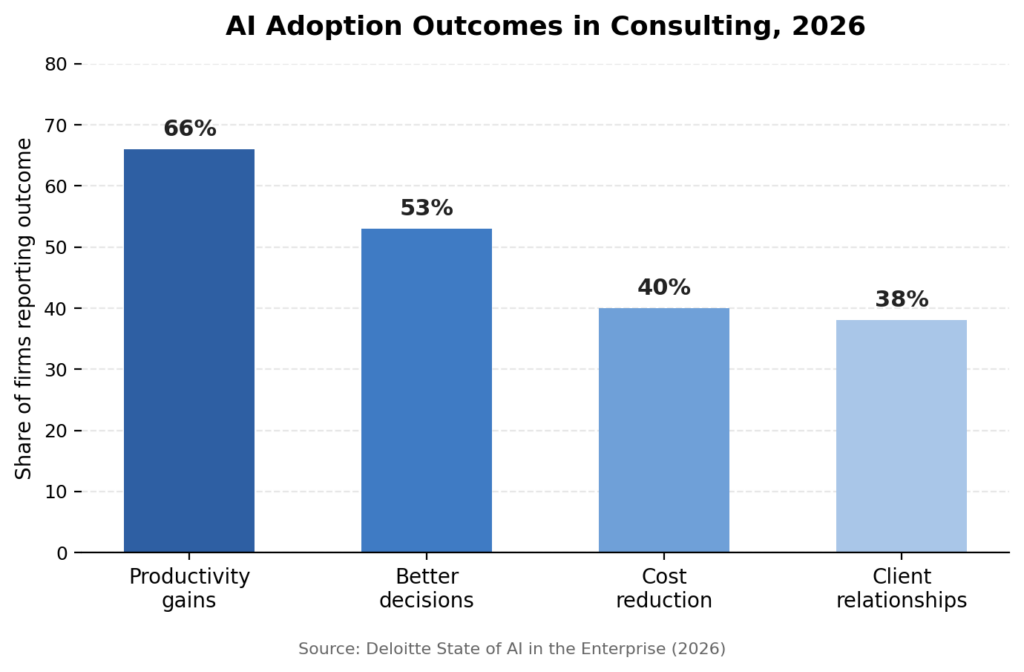
These numbers confirm a broader trend. Clients now expect AI-driven forecasting as a standard deliverable, not an upsell.
Predictive Business Modeling Reshapes Client Deliverables
Predictive business modeling has moved from finance teams into strategy departments. Consultants now build models that update automatically as conditions change.
Older predictive models froze the moment they were delivered. A client received a static PDF, then manually reran the numbers months later.
Newer models stay connected to live data feeds. They recalculate probabilities as market signals shift in real time.
Where Predictive Business Modeling Adds the Most Value
- Demand forecasting. Retail and manufacturing clients spot shifts earlier.
- Risk exposure mapping. Financial clients quantify tail risks with more precision.
- Workforce planning. HR leaders simulate hiring needs under multiple demand scenarios.
Gartner’s workforce planning research offers a striking example here. It found that AI-driven scenario planning cut planning cycle time by a median of 47 percent. That gain came compared with manual headcount modeling approaches.
Sixty percent of HR leaders reported using AI for strategic workforce decisions in 2025. That figure was just 29 percent back in 2023. Adoption nearly doubled within two years.
A Composite Example From the Field
Picture a mid-size retailer facing volatile shipping costs. Its consulting team once built one demand forecast per quarter.
Under the new approach, the team instead builds twenty scenarios weekly. Each scenario models a different combination of fuel prices, tariffs, and consumer demand.
The AI system flags which scenarios carry the highest probability. Consultants then translate those signals into inventory and pricing recommendations.
Leadership no longer waits for a quarterly review to react. They adjust strategy within days, based on shifting scenario weights.
This example is representative, not a single named firm. Similar patterns show up across industries adopting these methods now.
AI in Management Consulting: A Structural Shift
AI in management consulting is changing more than tools. It is reshaping how firms staff projects and price engagements.
Junior analysts once spent most hours building spreadsheets manually. Firms now redirect that time toward interpreting AI output instead.
This shift raises the bar for junior talent. Analysts need stronger judgment skills, not just technical modeling ability.
New Skills Firms Are Prioritizing
- Interpreting probabilistic outputs, not just building formulas.
- Spotting flawed assumptions inside AI-generated scenarios.
- Communicating uncertainty clearly to skeptical executives.
McKinsey’s research adds an important caution here. It found that 88 percent of organizations use AI regularly. Yet only about 39 percent report any real earnings impact.
That gap matters for consulting firms selling AI-enabled services. Clients want proof of value, not just impressive technology demonstrations.
Risks and Limits Consultants Must Manage
AI scenario planning is powerful, but it carries real risks. Models can produce confident-looking outputs built on flawed data.
Consultants must audit training data quality before trusting any forecast. Gartner warns that many AI projects stall due to weak data foundations.
Bias inside historical data can also skew future scenarios. A model trained on stable years may underestimate genuine disruption ahead.
Guardrails Leading Firms Now Require
- Human review of every high-stakes scenario before client delivery.
- Clear documentation of model assumptions and data sources.
- Regular recalibration as new information becomes available.
Firms that skip these guardrails risk delivering false confidence. That outcome could damage client trust far more than slow forecasting ever did.
What This Means for Clients Choosing a Consulting Partner
Clients evaluating consulting firms should ask pointed questions now. They should ask how scenarios get built, tested, and updated over time.
A firm relying only on legacy spreadsheets may fall behind quickly. One using transparent, well-governed AI models offers a real advantage.
Clients should also ask about human oversight within the process. Strong firms combine machine speed with experienced human judgment.
The Road Ahead for Forecasting
AI scenario planning has moved from novelty to necessity within a few years. Consultants who master it will win larger, more strategic mandates.
Those still relying on annual forecasts risk looking outdated fast. Clients increasingly expect continuous, adaptive planning as the new baseline.
The firms leading this shift share a common trait. They pair strong technology with disciplined human oversight, not blind automation.
Forecasting will never be perfectly certain, even with advanced AI tools. But 2026 is already proving one thing clearly. Smarter, faster, and more transparent forecasting is now within reach for every consulting client.