How to Choose the Right Business Consultant: A 2026 Buyer’s Guide
by Sovina Vijaykumar

Every year, owners hand consultants large budgets they barely know. Some win big. Others lose months and money. The gap rarely comes from luck. It comes from process.
This business consultant guide gives you a practical method for 2026. You will learn how to choose a business consultant who fits your goals, budget, and technology stack. Each step ends with an action you can take today.
Why 2026 Demands a Careful Search
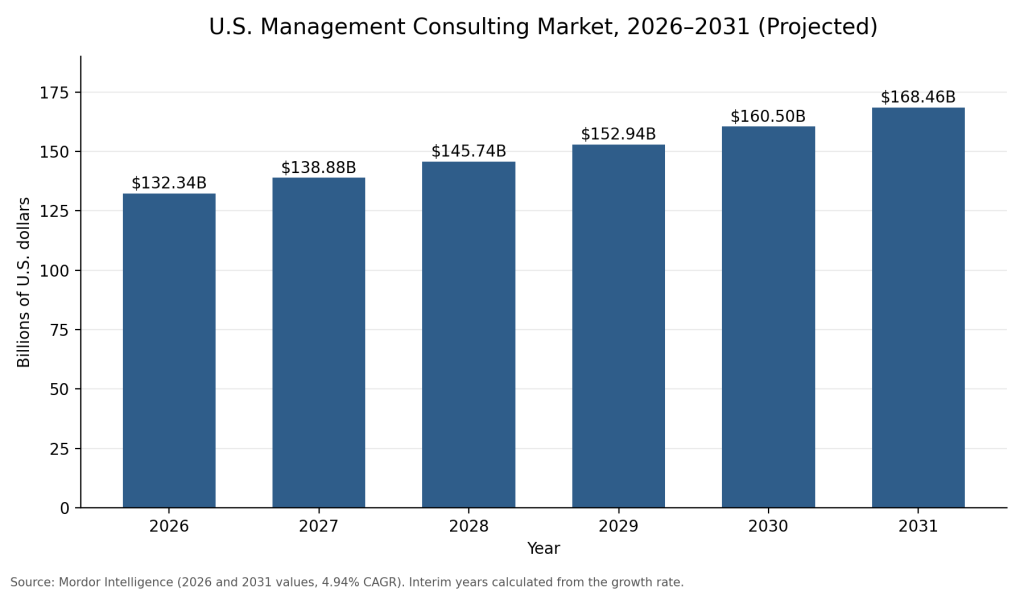
The consulting field is huge and crowded. Mordor Intelligence sizes the U.S. management consulting market at $132.34 billion for 2026, heading toward $168.46 billion by 2031. That path implies growth near 4.94% each year.
IBISWorld counts 1,109,213 U.S. consulting businesses in 2026, a 3.6% rise from 2025. More choice sounds helpful. In practice, it makes vetting harder.
Smaller companies now drive part of this demand. Mordor reports that small and midsize firms are gaining share at roughly 6% per year, helped by cloud platforms. Hiring a consultant is no longer a big-enterprise habit.
The table below shows the projected path. The years between 2026 and 2031 are calculated from Mordor’s published growth rate.
Step 1: Define the Problem First
Many buyers start by browsing profiles. That order backfires. Write a problem statement before you contact anyone.
Answer these questions on paper:
- What result do you need, and by what date?
- Which metric will prove success?
- Who inside your company owns the outcome?
- What budget range can you commit?
A vague brief attracts vague proposals. A sharp brief draws focused experts.
Also separate symptoms from causes. Slow sales might reflect weak pricing, a leaky funnel, or a broken CRM. Strong consultants test each theory before they recommend a fix.
Action: Draft a one-page brief and share it with your leadership team.
Step 2: Match the Consultant Type to Your Need
Consultants specialize, so choose a category before you compare names.
- Strategy: Market entry, mergers, and long-term positioning.
- Operations: Cost control, supply chains, and process design. This category held 29.15% of the market in 2025.
- Technology advisory: Cloud migration, data architecture, and cybersecurity. Mordor expects it to grow 5.88% per year through 2031.
- Growth and marketing: Demand generation, analytics, and brand.
Firm size matters as well. A solo expert offers flexibility and lower rates. A large firm brings deeper benches and global reach. Midsize boutiques often balance both.
Action: Pick the single category closest to your problem.
Step 3: Verify Credentials and Proof
Evidence beats slogans. Request proof in four forms:
- References: Ask for three clients with similar size and industry. Call at least two.
- Case studies: Look for a baseline, an action, and a measured result.
- Credentials: Check for the CMC designation from the Institute of Management Consultants USA, plus field-specific certifications.
- Public record: Read published articles, conference talks, and independent reviews.
Trust drives these decisions. One Source Global Research survey found that 87% of clients ranked trust as more important when buying consulting services after the pandemic began. Earn that trust through checks, not handshakes.
Step 4: Test Their Technology Skills
Modern consulting runs on data. Probe how each finalist works.
- Analytics: Ask which tools they use, such as Power BI, Tableau, or Looker.
- Security: Request a SOC 2 report or a written security policy. Sign an NDA first.
- Automation: Ask where they use automation and where humans review results. Confirm that your data never trains outside models without consent.
- Integration: Check whether they can work inside your CRM, ERP, and project tools.
- Reporting: Insist on a live dashboard or weekly written updates.
A consultant who cannot explain their toolkit clearly probably lacks depth. Technology fluency now separates average advisors from excellent ones.
Action: Add three technology questions to every interview.
Step 5: Compare Pricing Models
Fees vary widely, so understand the structure before you compare totals.
- Hourly: This fits short, uncertain work. A Credo survey of more than 600 providers found that digital marketing consultants average $141.67 per hour.
- Fixed fee: This suits defined projects with clear deliverables.
- Retainer: This works for ongoing advisory support.
- Outcome-based: Mordor notes that cash-constrained clients like sharing upside rather than funding hourly retainers.
For context, federal data lists median pay for management analysts at $99,410 per year. Use that figure as a baseline. Independents also cover taxes, benefits, and unpaid downtime, so their rates run higher.
Ask for line-item estimates. Define how the team prices change requests.
Step 6: Interview for Fit
Meet two or three finalists. Ask each to outline the first 30 days. Listen for specifics, and notice who asks hard questions.
Watch for these red flags:
- Guaranteed results
- Pressure to sign quickly
- Reluctance to share references
- No written scope
- A senior pitch team replaced by junior staff after signing
Chemistry matters because consultants work closely with your people. Choose someone your team will actually trust.
What a Strong Proposal Contains
A good proposal mirrors your brief. Look for these elements:
- Your problem, restated in the consultant’s own words
- A clear method with defined phases
- Named team members and their roles
- A timeline with milestones
- Risks and assumptions, listed openly
- Pricing tied to deliverables
Weak proposals recycle generic slides. Strong ones show real thought about your business. Reject any document that could fit another client.
Step 7: Score Your Finalists
A scorecard removes bias. Rate each finalist from 1 to 5, then multiply by the weight.
| Criterion | Weight |
|---|---|
| Relevant experience | 25% |
| Verified references | 20% |
| Technology and security skills | 20% |
| Communication and cultural fit | 20% |
| Pricing clarity and value | 15% |
Tally the totals with your team. Discuss any gap larger than one point.
Step 8: Lock In a Clear Contract
Good contracts protect both sides. Include these items:
- Scope and deliverables
- Milestones with dates
- KPIs tied to your problem statement
- A payment schedule linked to milestones
- Intellectual property ownership
- Confidentiality and data handling terms
- A 30-day exit clause
Consider a paid pilot lasting four to six weeks. A pilot reveals real working style before you commit a full budget.
Mistakes That Derail Engagements
- Choosing the lowest bidder. Cheap work often creates costly rework.
- Skipping internal buy-in. Staff resist changes they did not shape.
- Leaving goals fuzzy. Scope creep follows quickly.
- Ignoring the handoff. Knowledge leaves when the consultant does.
Avoid these four traps, and your odds improve sharply.
Consulting Buyer Tips to Remember
These consulting buyer tips save time and money:
- Compare at least three proposals.
- Never skip reference calls.
- Share sensitive data only after signing an NDA.
- Assign one internal owner to the project.
- Review progress every two weeks.
- Plan knowledge transfer so your team keeps the skills.
Final Thoughts
Choosing well takes discipline, not luck. Define your problem, match the specialty, verify proof, test technology, compare pricing, interview for fit, score finalists, and sign a clear contract.
Follow this order, and hiring a consultant becomes a controlled investment instead of a gamble. Use this business consultant guide as a checklist before each engagement. Now you know how to choose a business consultant with confidence.
Also read: https://katharosconsultancy.com/why-generalist-consultants-are-losing-ground-to-specialists-in-2026/