EU AI Act Article 50: What Every Business Needs to Know After August 2026
by Sovina Vijaykumar

August 2, 2026, changed the compliance landscape for companies across Europe. On that date, EU AI Act Article 50 moved from legal text to daily reality. Businesses that build chatbots, generate synthetic media, or deploy emotion-recognition tools now carry binding duties. Regulators can enforce these duties immediately, with no further delay.
Many firms assumed the broader AI Act timeline gave them breathing room. That assumption proved costly. The Digital Omnibus package pushed the high-risk system deadline to December 2027. Article 50, however, stayed on schedule. Its transparency rules apply now, regardless of a system’s risk classification.
This article breaks down what the provision requires, who it covers, and how businesses should respond.
What Article 50 Actually Requires
Article 50 sits apart from the AI Act’s risk-based framework. It applies broad AI transparency obligations to specific categories of systems, no matter their risk tier. The rule targets one core problem: people often cannot tell when they are dealing with AI.
The provision breaks into four distinct duties.
Direct Interaction Disclosure
Providers of chatbots, voice assistants, and similar tools must make AI involvement obvious. A reasonably informed user must recognize they are talking to a machine. This duty falls away only when the AI nature is already clear from context.
Machine-Readable Marking
Providers of generative AI systems must mark outputs so machines can detect them. This marking must survive common editing and compression. It applies to audio, image, video, and text content produced by the system.
Emotion and Biometric Disclosure
Deployers of emotion-recognition or biometric-categorization systems must inform affected individuals. This duty rests with the deployer, not the underlying technology provider. Workplace and public settings both trigger it.
Deepfake and Public-Interest Content Labeling
Deployers must disclose deepfakes and AI-generated text on public matters. This is where AI content labeling becomes a hard legal requirement rather than a best practice. Human editorial review can exempt the publisher from this duty.
Who Falls Within Scope
Article 50 reaches further than most provisions in the regulation. It covers providers and deployers, including those offering open-source systems. Neither group receives a blanket exemption.
Geography also does not limit the rule.
- A company established outside the EU still qualifies if its system reaches EU users.
- A UK chatbot serving EU customers falls squarely within scope.
- Synthetic content shown to EU audiences triggers the duty, wherever it was produced.
This extraterritorial reach means AI Act compliance in 2026 is not just a European problem. American, Asian, and UK companies with any EU-facing AI product must act.
Sector-Specific Implications
Different industries face different exposure under this provision.
Retail and E-Commerce
Product recommendation chatbots and virtual shopping assistants often interact directly with shoppers. Retailers must confirm these tools clearly disclose their AI nature. Many current implementations blur this line through friendly branding.
Media and Publishing
Newsrooms using AI drafting tools face the sharpest scrutiny. Article 50(4) targets exactly this use case. Editorial teams must document human review to preserve any exemption.
Human Resources and Recruitment
Emotion-recognition tools sometimes appear inside interview software or engagement platforms. HR teams rarely realize these fall under Article 50(3). Employers must notify candidates and employees before deployment.
Financial Services
Fraud-detection systems using biometric categorization carry similar disclosure duties. Banks already manage heavy compliance loads. Adding transparency obligations requires close coordination between legal and product teams.
The Compliance Timeline in Detail
Understanding the dates matters as much as understanding the rules.
Article 50’s obligations apply from August 2, 2026, for any system newly placed on the market. Systems already operating before that date received a narrow grace period. This grace period covers only the machine-readable marking duty under Article 50(2). Those providers have until December 2, 2026, to retrofit detection capability.
Content published before August 2, 2026, does not need retroactive labeling. Content generated earlier but published after that date does require it. Deepfake disclosure and public-interest text labeling have no grace period.
By February 2, 2027, signatories to the voluntary Code of Practice must have interoperable watermark-detection tools ready. The Commission and AI Board have confirmed this Code as an adequate path toward demonstrating compliance.
Why the Stakes Are High
Noncompliance carries real financial consequences. Fines can reach 15 million euros or 3 percent of global annual turnover, whichever is larger. National market surveillance authorities can enforce these penalties starting immediately.
The AI Office has also launched reporting tools. Individuals and businesses can flag suspected violations directly to regulators. This creates a new layer of scrutiny beyond formal audits.
Business Readiness Remains Low
Survey data paints a troubling picture of preparation levels. A 2026 Deloitte survey found that only 35.7 percent of managers felt adequately prepared for AI Act duties. Meanwhile, 19.4 percent described their organization as poorly prepared.
Separate research from Vision Compliance found something starker. Roughly 78 percent of enterprises across eight industries had taken no meaningful compliance steps. Only 26.2 percent had started concrete activities.
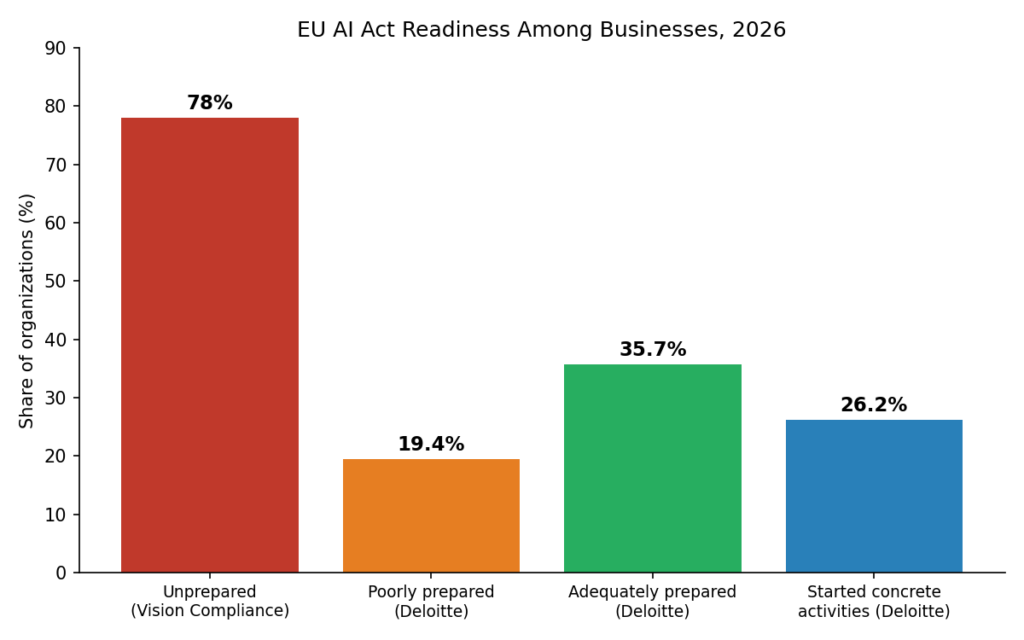
Sources: Deloitte AI Act Compliance Survey 2026; Vision Compliance 2026 EU AI Act Readiness Analysis.
These numbers suggest a significant gap between regulatory reality and organizational action. Companies that delay further risk both fines and reputational damage.
Practical Steps Toward Compliance
Businesses should not treat this provision as a legal afterthought. A structured response works better than scattered fixes.
Build a System Inventory
Start by cataloging every AI system touching EU users. More than half of surveyed organizations still lack this basic inventory. Without it, nothing else in a compliance program can function properly.
Classify Each System Against Article 50
Determine which duty applies to each tool. A customer service chatbot triggers disclosure duties. A synthetic image generator triggers marking duties. Some tools trigger more than one obligation simultaneously.
Update Vendor Contracts
Ensure agreements allocate responsibility along the supply chain. Providers and deployers often share the same underlying technology. Contracts should specify who handles marking and who handles disclosure.
Train Content and Editorial Teams
Human review can exempt certain public-interest content from labeling duties. Editorial teams need clear criteria for when that exemption genuinely applies. Sloppy documentation undermines the exemption during an audit.
Monitor the Guidelines Closely
The Commission adopted detailed guidelines on July 20, 2026. These clarify scope, exemptions, and practical steps for both providers and deployers. Guidance will likely keep evolving as enforcement experience accumulates.
Common Mistakes Businesses Are Making
Several patterns recur across noncompliant organizations.
- Treating the entire AI Act as delayed until 2027, ignoring Article 50’s separate timeline.
- Assuming machine-readable marking alone satisfies deployers’ deepfake disclosure duties.
- Failing to distinguish provider responsibilities from deployer responsibilities in mixed supply chains.
- Overlooking emotion-recognition tools embedded in customer analytics or HR software.
Each mistake carries direct enforcement risk. Regulators have shown little patience for confusion between provisions.
Frequently Asked Questions
Does Article 50 apply to small businesses?
Yes. The provision contains no size-based exemption. A small startup building a chatbot faces the same disclosure duty as a large enterprise.
Can a privacy policy satisfy the disclosure requirement?
No. Disclosure must be clear and perceivable at the point of interaction. Burying AI notices inside lengthy policy documents will not meet the standard.
What counts as a public-interest matter under Article 50(4)?
Guidance points toward topics like elections, public health, and civic affairs. Content must be published, informative, and reach a public audience. Purely internal or personal content generally falls outside this duty.
Does open-source AI receive an exemption?
No. Open-source providers and deployers remain fully within scope. The regulation makes no distinction based on licensing model.
Looking Ahead
Article 50 represents a shift in how companies must think about AI. Transparency is no longer optional or aspirational. It is now a binding legal floor across the European market.
Businesses that build compliance programs now will face fewer surprises later. Those still waiting risk joining the 78 percent already behind. The window for casual preparation has closed.
Regulatory momentum will likely intensify through 2027. Companies that treat AI transparency obligations as core product design, not legal paperwork, will adapt faster. That mindset shift matters more than any single checklist.
Boards and executive teams should ask a simple question this quarter. Does every customer-facing AI tool clearly and consistently disclose itself? If the honest answer is no, let’s put the fix on this week’s agenda, not next year’s roadmap. Article 50 rewards businesses that act early and penalizes those that stall.