From Strategy Decks to Operating Reality
by Sovina Vijaykumar
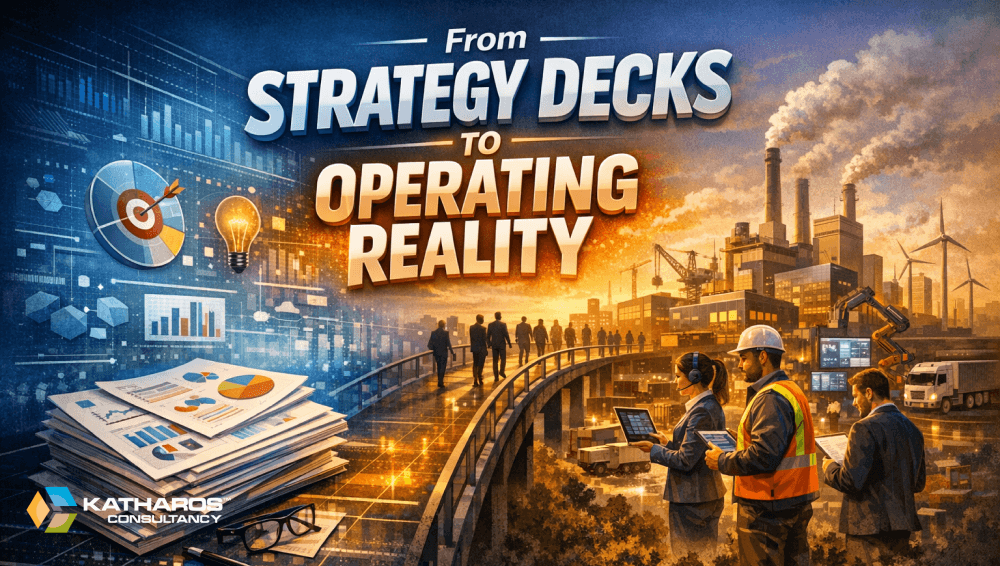
Most companies do not fail because they lack strategy. They fail because strategy never fully translates into execution. The slide deck looks sharp. The vision is clear. The roadmap feels convincing. Yet somewhere between planning and action, momentum breaks.
Here’s the thing. Strategy lives in intention. Operations live in systems. And the gap between the two is where most organizations struggle, especially as they grow.
This gap becomes even more visible in high-growth environments. What begins as clarity at the top often turns into confusion across teams. As a result, execution drifts, priorities blur, and outcomes fall short. This is where governance, often overlooked early on, becomes critical.
The Illusion of Strategy Alignment
At the leadership level, alignment often feels real. Founders and executives agree on direction. They define goals, identify markets, and outline priorities. However, alignment at the top does not guarantee alignment across the organization.
As companies scale, the number of communication layers increases. Teams expand. New roles emerge. Decisions that once took minutes now require approvals, coordination, and context. Consequently, the original strategy begins to dilute.
This is why governance fails in organizations, which becomes a serious question. Governance is supposed to carry strategy into execution. Instead, it often lags behind growth.
When Growth Outpaces Structure
Scaling introduces a new kind of complexity. Early-stage startups rely on speed and intuition. Decisions happen quickly. Founders remain close to execution. However, as growth accelerates, this model breaks.
Teams multiply. Products diversify. Markets expand. Technology stacks become more layered. At this point, informal systems stop working.
These are classic scaling startup problems:
- Decision-making slows down
- Accountability becomes unclear
- Teams operate in silos
- Execution loses consistency
At the same time, leaders try to maintain control without building the right systems. As a result, governance becomes reactive instead of structured.
This is where governance challenges begin to surface for scaling companies.
Governance Is Not Bureaucracy
Many organizations misunderstand governance. They associate it with rigid rules, excessive approvals, and unnecessary control. As a result, they delay implementing governance frameworks.
However, governance is not about restriction. It is about clarity.
Strong governance defines:
- Who makes which decisions
- How information flows
- What accountability looks like
- How performance is measured
Without these elements, execution becomes fragmented. Teams move in different directions, even when they share the same goals.
This fragmentation directly leads to a breakdown in organizational governance.
The Core Reasons Strategy Fails in Execution
Let’s break this down further. The failure to move from strategy decks to operating reality usually comes down to a few critical gaps.
1. Misaligned Decision-Making
Strategy defines direction, but execution depends on decisions made daily across teams. When decision rights are unclear, teams either hesitate or act independently without alignment.
As a result, outcomes become inconsistent.
2. Weak Management Structures
A growing company cannot rely on founder-driven execution forever. It needs a defined management structure for growing business operations.
Without it:
- Managers lack authority
- Teams lack guidance
- Execution lacks ownership
Eventually, leaders become bottlenecks.
3. Technology Without Integration
Modern organizations rely heavily on technology. However, many scale with disconnected systems. Different teams use different tools. Data sits in silos.
This creates:
- Inconsistent reporting
- Delayed insights
- Poor decision-making
In fast-growing environments, this becomes one of the biggest governance problems in fast-growing companies.
4. Lack of Real-Time Visibility
Leaders often rely on outdated or incomplete data. By the time issues surface, they have already escalated.
Without real-time visibility:
- Risks go unnoticed
- Performance gaps widen
- Strategic adjustments come too late
5. Cultural Resistance
Early employees often resist structure. They associate governance with loss of autonomy. While this mindset works in early stages, it becomes a liability at scale.
Over time, resistance slows down necessary change.
The Hidden Cost of Hypergrowth
Hypergrowth looks impressive from the outside. Revenue increases. Headcount expands. Market presence grows. However, internally, pressure builds.
Hypergrowth company governance often struggles to keep up with:
- Rapid hiring
- Expanding operations
- Increasing compliance requirements
Without strong governance, growth creates instability instead of strength.
This leads to:
- Operational inefficiencies
- Increased risk exposure
- Declining execution quality
In many cases, companies reach a point where growth slows, not because of market conditions, but because internal systems cannot support scale.
When Governance Breaks, Execution Follows
Governance failures rarely appear suddenly. They build gradually.
Early warning signs include:
- Teams creating their own processes
- Conflicting metrics across departments
- Frequent misalignment in priorities
- Increasing reliance on leadership for minor decisions
These signals indicate a deeper issue. The organization lacks a system that connects strategy to execution.
This is the essence of why governance fails organizations during scaling phases.
Bridging the Gap: From Strategy to Execution

Moving from strategy decks to operating reality requires intentional design. It does not happen automatically. Organizations must build systems that support execution at scale.
This is where scaling organization consulting plays a key role. Companies need structured approaches, not ad hoc fixes.
Let’s look at what actually works.
Building Governance That Scales
1. Define Decision Architecture
Start by clarifying decision rights. Identify:
- Strategic decisions
- Operational decisions
- Team-level decisions
Assign ownership clearly. This reduces confusion and speeds up execution.
2. Establish a Strong Management Layer
A clear management structure for a growing business ensures that strategy flows through the organization.
Managers should:
- Translate strategy into actionable plans
- Align team priorities
- Ensure accountability
This layer acts as the bridge between leadership and execution.
3. Integrate Technology Systems
Technology should enable governance, not complicate it.
Focus on:
- Unified data platforms
- Integrated workflows
- Automated reporting
This improves visibility and supports faster decision-making.
4. Build Real-Time Visibility
Leaders need access to accurate, real-time data.
Dashboards should provide:
- Performance metrics
- Operational insights
- Risk indicators
This allows for proactive adjustments rather than reactive fixes.
5. Standardize Without Over-Controlling
Not every process needs strict control. However, critical areas require consistency.
Balance is key:
- Standardize core operations
- Allow flexibility in innovation areas
This approach supports both efficiency and growth.
6. Evolve Governance Continuously
Governance is not a one-time setup. It must evolve with the organization.
Regular reviews help:
- Identify gaps
- Adjust structures
- Improve systems
This prevents governance from becoming outdated.
The Role of Leadership
Leadership plays a decisive role in this transition. Strategy alone is not enough. Leaders must ensure that execution systems are in place.
This means:
- Prioritizing governance early
- Investing in systems and processes
- Encouraging accountability
Leaders who ignore governance often find themselves managing chaos instead of driving growth.
A Shift in Perspective
Organizations need to rethink governance. It is not a control mechanism. It is an enabler of scale.
When done right, governance:
- Speeds up decision-making
- Improves alignment
- Enhances execution
Without it, even the best strategies remain theoretical.
Conclusion
The journey from strategy decks to operating reality defines whether a company truly scales or simply grows.
Most organizations struggle not because they lack vision, but because they lack systems. As complexity increases, informal approaches fail. Governance becomes essential.
The real challenge is not growth itself. It is building structures that support growth without slowing it down.
In the end, companies that succeed are not the ones with the best strategies on paper. They are the ones that execute consistently, align effectively, and adapt continuously.
So the real question is simple.
Is your strategy driving execution, or is it still living in a deck?