The Role of Data-Driven Decision Making in Modern Businesses
by Sovina Vijaykumar
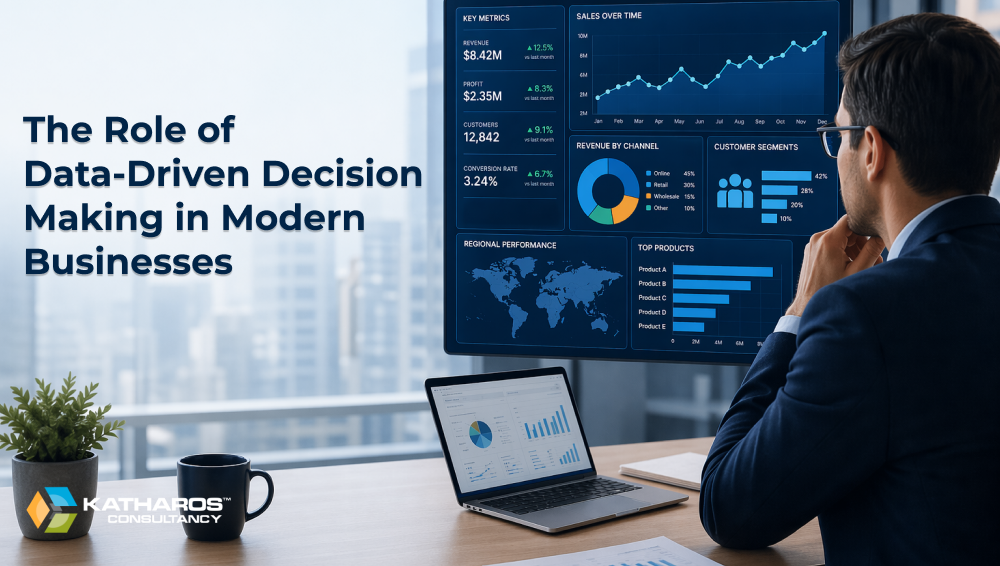
Executives who act on instinct alone are losing ground. The businesses that build a rigorous data-driven decision-making culture are pulling ahead, and the gap is widening faster than most leaders realize.
Markets have always rewarded businesses that read signals correctly and act on them before competitors do. But the sheer volume of information available today has shifted the rules of that game. Organizations now produce more operational data in a single week than they once generated in a year, and the companies that treat this as infrastructure rather than overhead are the ones setting the pace in virtually every sector.
This is not a trend exclusive to technology companies or retail giants. Manufacturers, healthcare networks, logistics providers, and professional services firms are all rethinking how decisions get made at every level of the organization. The underlying logic is consistent: decisions grounded in evidence consistently outperform decisions grounded in habit or hierarchy. What differs is the maturity of the systems organizations build to make that possible.
Why the Shift Is Happening Now
The conditions that make data-driven decision-making viable at scale did not exist a decade ago. Three forces have converged to make it the new standard rather than the exception.
- Cloud infrastructure now makes large-scale data storage and processing accessible to mid-market companies, not just enterprises with dedicated engineering teams.
- Machine learning platforms have matured to the point that analysts without deep ML expertise can deploy predictive models and surface actionable outputs.
- Business intelligence tools have moved decisively toward natural language interfaces, meaning decision-makers no longer need to wait for data teams to pull reports.
These shifts have significantly lowered the barrier to entry. However, they have also raised the expectations for what organizations should be able to do. A company that relies on monthly reports in 2026 is operating with the same strategic lag as one that relied on quarterly reports in 2010. The competitive environment has simply moved faster than that cadence allows.
Building a Business Analytics Strategy That Holds
Technology alone does not produce better decisions. Dozens of organizations have invested heavily in data platforms and seen little return because they never resolved the organizational questions that determine whether those platforms get used well. A sound business analytics strategy addresses three distinct layers: the data layer, the capability layer, and the governance layer.
1. The data layer: quality before quantity
The most common failure mode is accumulating data without establishing the standards that make it usable. Businesses frequently discover fragmented customer records across systems, inconsistent transaction logs, and varying reporting definitions across departments. None of this is unusual. What separates high-performing organizations is that they treat data quality as an ongoing operational priority rather than a one-time cleanup project.
- Establish data ownership at the domain level to ensure accountability when quality issues arise.
- Implement automated validation pipelines that catch anomalies before they propagate into reports and models.
- Maintain a data catalog that documents definitions, lineage, and update frequency for every key dataset.
- This becomes particularly critical when teams across functions draw from shared datasets with different interpretations.
- Consistent definitions prevent silent contradictions between finance, operations, and sales reporting.
2. The capability layer: building literacy across the organization
Analytics capability should not live exclusively in a central data team. Organizations that centralize all analytical work create bottlenecks and insulate decision makers from the evidence that should inform their choices. The goal is analytical literacy at the team level, supported by shared infrastructure and centralized expertise.
- Train functional leaders to interpret dashboards critically, not just consume the numbers at face value.
- Embed analysts within business units where decision cycles are fast, and context matters for data interpretation.
- Create self-service reporting environments that let managers explore data independently while respecting governance boundaries.
3. The governance layer: trust and accountability
Data governance sounds like a compliance function, and organizations frequently treat it as one. That misses its strategic value. Governance frameworks determine who can access what data, under what conditions, and with what accountability. When these frameworks are well-designed, they accelerate decision-making by removing ambiguity about who owns a decision and what information they are authorized to use.
- Define data access policies that are specific enough to be enforced but flexible enough to support legitimate business needs.
- Audit data usage regularly to identify gaps between policy and practice before they become regulatory or reputational problems.
- Connect governance metrics to business outcomes so decision quality reflects the value they enable, not just the rules they enforce.
What Consulting Insights Reveal About Adoption Gaps

Practitioners who work closely with organizations on analytics transformations surface a consistent pattern. The technical work is rarely the limiting factor. What slows adoption is a set of organizational dynamics that technology vendors rarely acknowledge and that internal champions often underestimate.
“The organizations that get the most value from their data investments are the ones that treat analytics as a change management program, not a technology program.”
The consulting insights that emerge from sustained client work point to several recurring friction points that organizations need to address directly.
- Decision rights ambiguity: When it is unclear who owns a decision, data does not resolve the confusion. It often amplifies it. Different stakeholders select the data that supports their existing positions, and the organization ends up in a slower, more sophisticated version of the arguments it was already having.
- Resolving this requires explicit mapping of decision rights before analytics initiatives go live.
- RACI frameworks, when applied to decision processes rather than just projects, help clarify accountability in a way that data can then inform.
- Incentive misalignment: Managers rewarded for short-term output metrics have little incentive to surface data that complicates the picture. Organizations that want honest use of analytics need to ensure that the performance systems they operate reward accurate diagnosis as much as strong results.
- Insight latency: Analysis that arrives after the decision window has closed is not useful. Organizations frequently invest in sophisticated models that deliver outputs too slowly to influence the decisions they need to support. Decision makers value speed and relevance as much as accuracy.
Where Advanced Analytics Is Changing the Equation
Beyond descriptive reporting and standard dashboards, a new class of analytical capability is reshaping what organizations can do with their data. These are not experimental techniques. They are production deployments that leading organizations are running at scale today.
Causal inference over correlation
Most business analytics systems surface correlations. A mature analytics strategy distinguishes between variables associated with an outcome and those that actually drive it. Causal inference methods, including difference-in-differences analysis, synthetic controls, and randomized testing, let organizations make this distinction reliably. This matters enormously for resource allocation decisions, where acting on a spurious correlation can be expensive.
Real-time decision systems
Batch processing is giving way to streaming architectures that continuously evaluate data and trigger decisions. Credit risk models, supply chain routing systems, and personalization engines now operate on millisecond decision cycles. Organizations that still rely on nightly batch jobs for operational decisions are introducing lag that their competitors have already eliminated.
Federated learning for sensitive domains
Healthcare, financial services, and other regulated industries face a specific challenge: the data that would most improve their models is the data they are least able to centralize. Federated learning approaches let models train across distributed datasets without moving sensitive information, which opens up analytical capabilities that were previously impractical under compliance constraints.
The Organizational Posture That Makes It Work
Organizations that sustain the value of data-driven decision-making over time share a common posture. They treat analytical capacity as a strategic asset rather than a support function. They invest in it continuously rather than episodically. And they hold their data initiatives accountable to business outcomes rather than to technical milestones.
This posture is harder to build than it sounds. It requires executives who are comfortable with probabilistic reasoning rather than certain answers, managers who surface inconvenient data rather than burying it, and teams that use analytical tools as thinking aids rather than decision substitutes. None of this is primarily a technology problem.
But organizations that build this capacity find that the compounding effects are real. Each decision that uses good data produces a better outcome. Each better outcome builds confidence in the analytical process. Each confident organization attracts the people and the data that make the next round of decisions better still. The feedback loop is slow to start and fast to accelerate.
The businesses that lead the next decade will not simply be the ones that collect the most data. They will be the ones who built the organizational discipline to use it well, consistently, and at the speed the market requires.