Tariff Volatility and Supply Chain Strategy: What Consultants Are Recommending in 2026
by Sovina Vijaykumar

Tariffs used to sit quietly in a spreadsheet cell. In 2026, they behave more like the weather. Rules change overnight, courts rewrite the playbook, and replacements arrive within hours.
The Supreme Court struck down the IEEPA tariffs on February 20. A 10% Section 122 surcharge followed, then expired on July 24. New Section 301 duties took effect that same minute.
Executives want answers, and many now turn to tariff consulting for them. The advice has grown surprisingly consistent. This post explains what advisors recommend for supply chain strategy 2026, and why each move matters.
The Numbers Behind the Anxiety
Survey data shows how fast sentiment shifted. Thomson Reuters polled 225 senior trade professionals in February 2026. Among them, 72% named U.S. tariff volatility the most impactful regulatory change, up from 41% a year earlier. Supply chain management also became the top priority for 68% of respondents, up from 35%.
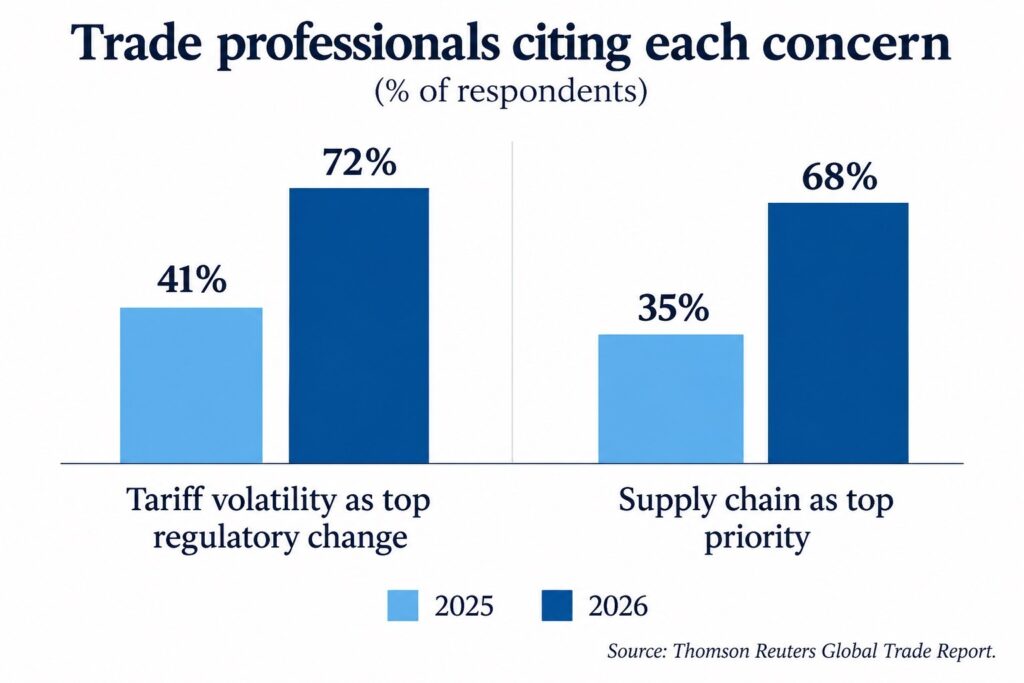
That jump shows how quickly tariffs moved from a side issue to a core planning problem. Few expect relief soon. In that same survey, 76% said the new tariffs look permanent, possibly lasting four years or more.
McKinsey’s survey of 100 supply chain leaders tells a similar story. Of those leaders, 82% said new tariffs affected their supply chains. Additionally, 39% saw higher supplier and material costs, while 30% saw weaker customer demand.
A Timeline of the 2026 Whiplash
Here is how the legal ground moved this year:
- Feb. 20: The Supreme Court ruled that IEEPA does not authorize tariffs.
- Feb. 24: A 10% Section 122 surcharge began, with a 150-day limit.
- July 24: Section 301 duties of 10% or 12.5% replaced it across 60 economies.
Don’t assume the Section 122 expiration cut your costs by 10%. New Section 301 tariffs may replace some or all of that reduction, depending on country, product, and exemptions.
That churn drives the trade policy business impact companies feel today. Unpredictability often does more damage than the rate itself.
Why the Uncertainty Won’t Fade
Courts add another layer of risk. The new Section 301 duties carry no statutory expiration, and challengers have already sued. Morgan Lewis notes that using Section 301 across 60 investigations raises legal questions courts haven’t tackled at this scale. Grant Thornton reports that officials planned to replace the struck-down tariffs with Section 301 and 232 duties.
Plan for two outcomes at once. A court could void the new duties, or officials could invoke yet another authority. Either result changes your landed costs, so your models must handle both.
What Consultants Recommend Right Now
Advisors across consulting and law firms keep circling seven moves.
1. Treat Tariffs as Strategy
McKinsey frames tariffs as a strategic topic, not a compliance chore. Its experts suggest a geopolitical nerve center, where cross-functional teams monitor risk and set next steps.
Finance, procurement, sales, and legal all feel the fallout. One siloed team can’t handle that alone. Assign the hub an executive sponsor with authority to move budget quickly.
2. Model Scenarios with Real Import Data
Deloitte urges companies to build scenario-based financial models from their import data. These models estimate cash flow and earnings effects before rates change.
Morgan Lewis adds two steps: update contract allocation clauses, and build tariff scenarios into procurement and pricing models. Refresh those scenarios monthly, since rates and rulings rarely wait for quarterly reviews.
Ask any supply chain disruption consultant where to start, and the answer usually involves data.
3. See Beyond Tier-One Suppliers
Visibility remains a weak spot. McKinsey reports that tier-two visibility has fallen seven percentage points since 2023. Tariffs often hit through hidden inputs, such as parts from second-tier factories. You can’t reroute what you can’t see.
Ask tier-one suppliers to disclose their own sources, and write that duty into contracts.
4. Diversify, but Stay Flexible
McKinsey finds that 60% to 73% of companies now adopt dual sourcing and regionalization. Yet moving every factory is risky, because legal authorities keep shifting. A plant that dodges one tariff today may face another next year.
Foley advises building flexibility into supply chains so that teams can respond quickly to legal and policy shifts. That means qualified backup suppliers, adaptable contracts, and shorter commitments.
5. Use Duty Mitigation Tools
Foley’s guidance also recommends evaluating foreign trade zones, bonded warehouses, and drawback programs. Teams can explore tariff engineering too, provided any production change follows customs rules. Finance should update ERP, landed-cost, and pricing systems to reflect current duties.
6. Claim Your IEEPA Refunds
The Supreme Court ruling opened a refund path for importers. Customs built an automated system, called CAPE, to process claims. Deadlines run on a rolling, per-entry clock tied to liquidation dates. Once a window closes, that entry loses eligibility for good.
Audit your entries now. Don’t let refund work distract you from new exposure. Teams may misapply updated tariff codes or reuse outdated origin assumptions.
7. Reset Pricing and Pass-Through
McKinsey found companies pass through only 45% of new tariff costs, on a weighted average. Thomson Reuters found 39% of firms absorbing or considering absorbing tariff costs, up from 13%. Margins can’t absorb that forever.
Set clear triggers for price changes, so sales teams don’t improvise. Netstock’s SMB survey shows the shift toward action. Only 21% now wait and watch, down from 57%.
What Smaller Companies Are Doing
Smaller firms feel the squeeze too. Netstock found that 72% of surveyed small and midsize businesses cite cost-related challenges, led by higher landed costs at 56%.
Yet nearly six in ten now deploy two or more mitigation tactics at once. Fewer than 3% report having no active strategy. The lesson for larger firms is simple: smaller rivals are moving, so waiting carries competitive risk.
The Technology Consultants Want in Your Stack
Spreadsheets can’t keep pace with rates that change monthly. Advisors point to three capabilities.
- Live classification and landed-cost engines. One analysis calls for real-time classification intelligence, dynamic landed-cost modeling, and early supplier qualification for alternate duty regimes.
- AI scenario simulators. According to one industry analysis, KPMG considers AI-powered scenario simulators essential. Teams test tariff shocks before they hit.
- Continuous risk monitoring. Leading manufacturers use AI-driven trade analytics to watch exposure continuously. Some also deploy autonomous agents to rebalance sourcing networks in near real time.
Better forecasting matters too. Models built on historical demand grow less reliable when most businesses raise prices together. Start small. Pilot one tool on your highest-risk product line before you scale.
What Waiting Costs
Inaction carries a price. A Doss survey found 43% of decision-makers delayed a major launch over tariff uncertainty. Another 45% held excess inventory longer than planned.
That’s trade policy business impact in plain terms: stalled launches, bloated warehouses, and eroded margins.
In the Doss survey, 40% began repricing affected goods, while 25% accelerated purchases to lock in pricing. Both moves buy time, but neither reduces underlying exposure.
Logistics providers in a Transport Topics survey report the same pattern. Some customers accelerated shipments and diversified sourcing, which created short demand bursts rather than steady volume.
How to Choose the Right Advisor
Not every firm offers the same help. Some focus on customs and legal exposure. Others focus on network redesign or software.
Before you sign, test any tariff consulting partner on four points:
- Data depth: Can they model your actual import entries, not industry averages?
- Legal fluency: Do they track Section 232, 301, and court rulings weekly?
- Execution: Will they help qualify suppliers, or only deliver slide decks?
- Speed: Can they update your scenarios within days of a policy change?
A seasoned supply chain disruption consultant should answer all four without hesitation.
A Practical 90-Day Plan
You don’t need a massive program to start. Try this sequence.
- Days 1 to 30: Audit import data, classifications, origin claims, and refund eligibility.
- Days 31 to 60: Build three tariff scenarios, and revise contract clauses and pricing rules.
- Days 61 to 90: Qualify backup suppliers, pilot a monitoring tool, and launch a cross-functional nerve center.
The Bottom Line
Tariff volatility isn’t a phase. Three-quarters of surveyed trade professionals expect these tariffs to last, and this year’s rulings showed how fast rules can flip.
The advisor playbook comes down to five habits. Know your exposure, see deeper into your suppliers, and stay flexible. Then use every duty tool and automate your monitoring. Those advisors agree on one point above the rest: flexibility beats prediction.
Companies that build these habits into supply chain strategy in 2026 will handle the next shock better than those that scramble. Start with your import data this week.
Sources: Thomson Reuters 2026 Global Trade Report, McKinsey Supply Chain Risk Pulse 2025, Deloitte, Morgan Lewis, Foley, Grant Thornton, Netstock, Doss, Transport Topics, and public legal analyses of the Section 122 and Section 301 actions.