Agentic AI in Consulting: Why the Big Four Are Replacing Decks with AI Agents
by Sovina Vijaykumar
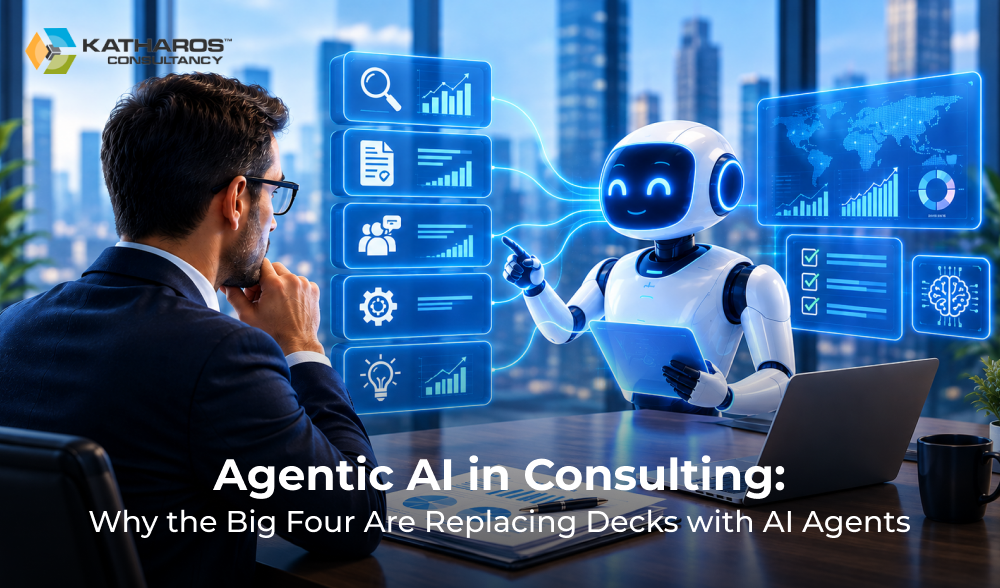
For decades, a consulting engagement ended with one familiar object: the deck. Slide after slide summarized findings, framed recommendations, and closed with a roadmap nobody quite followed. That era is fading fast. Deloitte, PwC, EY, and KPMG are now betting billions on agentic AI consulting. This model relies on software that acts, not just advises. The shift did not happen overnight. It reflects a broader industry move. Analysts already call it one of the biggest consulting trends August 2026 has produced.
The Deck Is Losing Its Throne
Clients used to pay for insight delivered in a PowerPoint. Today, they expect systems that keep working long after the final meeting ends.
A recent industry review described this exact change. Firms are shifting away from generalist teams that produce research and slides. Instead, they build tools, systems, and multi-year support structures.
KPMG’s vice chair of advisory, Rob Fisher, described this as embedding AI across every traditional offering. Clients increasingly want subscription-style products, not one-time advice.
That demand reshapes how firms staff projects. Fewer analysts spend time formatting slides. More engineers spend their days building and monitoring autonomous agents.
From Chatbots to Agents: What Actually Changed
Generative AI answers questions. Agentic AI takes action.
That distinction matters more than it sounds. A chatbot drafts a paragraph when asked. An agent can research a market, pull data from five systems, and draft a report. It flags risks without waiting for instructions at each step.
This capability turns AI agents in business from a novelty into infrastructure. Consulting firms no longer pitch AI as an add-on. They pitch it as the delivery engine itself.
The technical leap matters, but the business motive matters more. Clients grew tired of paying premium rates for research their own teams could gather. They now demand outcomes, not observations. Agentic systems promise exactly that: continuous execution instead of a single, static recommendation.
Why the Big Four Bet Billions on Agents
Cost pressure and client demand both point toward the same solution.
Corporate budgets tightened after years of economic uncertainty. Clients began questioning traditional hourly billing models. Meanwhile, software companies started building AI features directly into their own platforms, threatening the advisory layer consulting firms once controlled. Agentic AI offered a way to defend that territory while cutting delivery costs.
The resulting numbers explain the urgency:
- Big Four firms have collectively committed more than five billion dollars toward agentic platforms.
- PwC’s Agent OS has logged over 31 million interactions since launch.
- EY has committed one billion dollars specifically toward AI in audit engagements.
- Accenture added nearly 40,000 AI and data professionals over two years.
- EY added 61,000 technologists since 2023.
These figures signal a permanent restructuring, not a passing pilot phase. Firms are not experimenting anymore. They are scaling.
Inside the Big Four Agent Rollouts
Each firm chose a distinct path toward automation.
Deloitte focused heavily on governance and compliance workflows. Its agents assist with regulatory review and risk scoring across large engagements.
PwC built Agent OS as an internal operating layer. Employees route tasks to specialized agents instead of manual workflows.
EY poured resources directly into audit. Its agents scan transactions, flag anomalies, and reduce manual sampling work.
KPMG emphasized subscription-style delivery. Clients now access ongoing agent-powered services rather than static reports.
Together, these rollouts mark a new phase in agentic AI consulting, where automation touches nearly every service line.
The Data Behind the Shift
Survey data backs up what firms already sense internally.
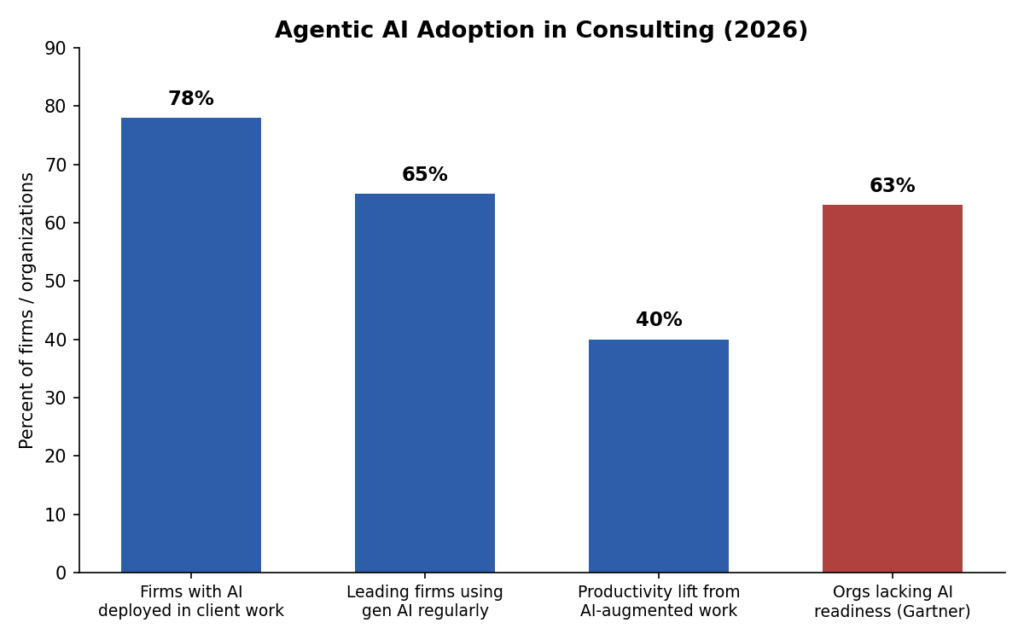
Roughly 78 percent of consulting firms had already deployed AI tools in client projects by 2023. That number has only climbed since.
About 65 percent of leading firms now use generative AI regularly across daily operations. AI-augmented consulting teams also report 40 percent higher output quality. Delivery timelines run 25 percent faster, according to joint Harvard and BCG research.
Gartner data adds a note of caution. Roughly 63 percent of organizations still lack the infrastructure to execute AI projects fully. The appetite exists. Readiness often lags behind it.
AI Agents in Business: Beyond the Big Four
This shift extends well past the largest firms.
Boutique consultancies now compete differently. Rather than growing headcount, some run lean teams of five to ten senior consultants. AI tools multiply what each person can deliver.
This approach lowers overhead while shortening project timelines. Clients also gain direct access to experienced consultants instead of trainees still learning the ropes.
Across industries, AI agents in business now handle contract review, financial modeling, customer research, and compliance monitoring. Consulting firms simply reflect a pattern already spreading through their client base. Manufacturing companies deploy agents for supply chain forecasting. Retail chains use them for dynamic pricing decisions. Even law firms lean on similar systems for document review.
The Rise of AI Native Consulting
A new category of firm has emerged alongside this shift: the AI native consultancy.
These firms never built a traditional pyramid of junior analysts. Instead, they design their entire operating model around AI from day one.
AI native consulting firms typically feature flatter structures. Analysts, once hired by the dozen, get replaced by smaller pods of senior specialists working alongside autonomous agents.
Boston Consulting Group research describes new roles emerging inside this structure. Professionals now focus on agent orchestration, prompt governance, and outcome validation rather than manual research.
This does not eliminate junior roles. It does change what those roles require. Technical fluency now matters as much as strategic thinking.
Risks Firms Cannot Ignore
Speed brings new problems alongside new efficiency.
Agents can misread context or produce confidently wrong conclusions. In audit and compliance work, that risk carries real financial consequences. Firms now invest heavily in oversight layers, human review checkpoints, and explainability tools to catch errors before clients see them.
Client trust remains fragile too. Many executives still worry about handing sensitive data to autonomous systems. Firms address this by keeping humans accountable for every agent decision, even when the agent does the heavy lifting.
Talent concerns persist as well. Entry-level roles are shrinking in some practice areas. That raises a question: where will future senior consultants come from without early training?
How Clients Are Responding
Buyers of consulting services notice the shift too.
Procurement teams increasingly ask vendors to prove agentic capability before signing contracts. A firm pitching only research and slides now struggles against rivals offering working systems.
Pricing conversations have changed as well. Clients push back on hourly billing when software does much of the analytical lifting. Many now request outcome-based contracts instead, tying fees to measurable results rather than hours logged.
This pressure benefits smaller, technically sharp firms. A boutique with strong agentic tooling can now compete for work once reserved for giants with thousands of staff. Scale still matters for global rollouts, but it no longer guarantees the win.
What This Means for Consultants
Entry-level hiring has not disappeared, but its shape has changed.
Analysts increasingly work alongside AI tools rather than instead of them. Data analysis, technical implementation, and agent supervision now count among core skills.
McKinsey estimates that generative AI can lift knowledge-work productivity by roughly 40 percent. That number matters beyond consulting itself. It shapes how many people finance departments believe they actually need.
Career paths are shifting too. The consultant of the future increasingly resembles an orchestrator. These professionals design frameworks, set ethical guardrails, and define strategy for the agents that execute it.
Consulting Trends August 2026: Where the Market Stands
Multiple signals point in the same direction this year.
- AI-enabled delivery has become table stakes rather than a differentiator.
- Enterprises are moving past early pilots and toward embedded agentic systems.
- Firms increasingly compete on execution speed, not just strategic insight.
- UK consultants forecast 5.7 percent growth in 2026, driven largely by digital and AI demand.
Analysts tracking consulting trends in August 2026 describe an industry in the middle of structural change. Strategic advisory alone no longer wins client trust. Measurable outcomes do.
The Road Ahead
Decks will not vanish completely. Some presentations will always accompany major decisions.
But the artifact clients pay for has changed. They now expect running systems, not static summaries. They want agents that keep working after the meeting ends.
The Big Four understand this shift clearly. Their billions in investment prove it. Firms that fail to adapt risk losing relevance to boutique competitors built around AI from the start.
Agentic AI consulting is not a passing trend. It reflects a permanent redefinition of what consulting actually delivers.