Fractional Executives Explained: CFOs, CMOs, COOs, and CAIOs on Demand
by Sovina Vijaykumar

A quiet shift is underway in corner offices nationwide. Companies that once assumed a C-suite seat required a full-time hire now build leadership teams differently. They bring in senior talent for a set number of hours each week, get real results, and skip the six-figure salary that used to come with the title. This is the world of fractional executives, and it is growing faster than almost anyone predicted.
The global market for this model reached roughly $8.6 billion in 2025 and is projected to climb toward $34.2 billion by 2034, according to Growth Market Reports. That trajectory reflects a 16.2 percent compound annual growth rate, outpacing most traditional staffing categories by a wide margin.
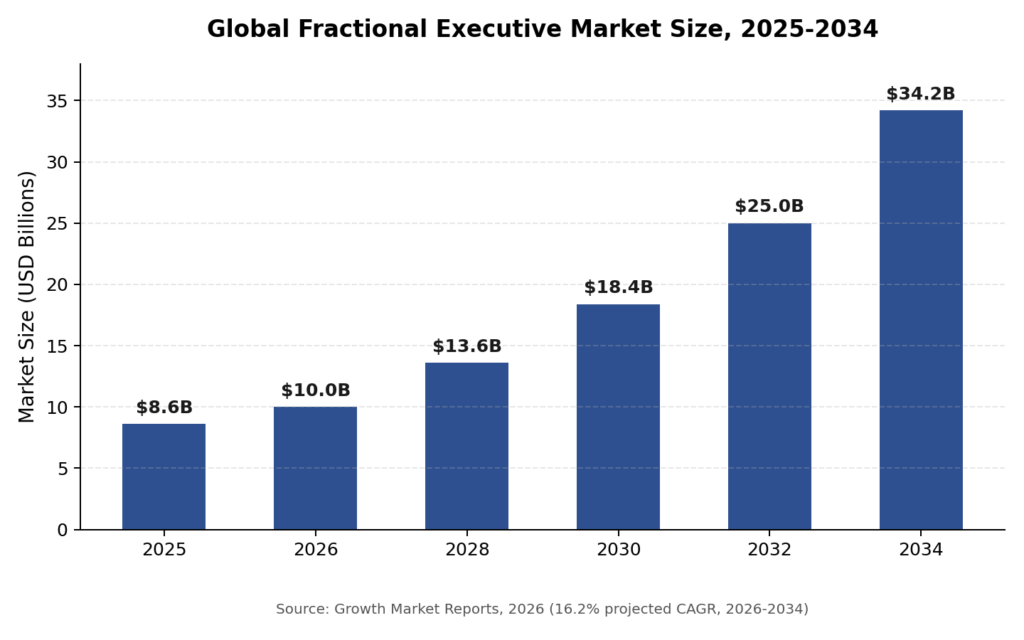
[Chart: Global Fractional Executive Market Size, 2025–2034 — growing from $8.6B to $34.2B]
What Is a Fractional Executive?
A fractional executive is a senior leader who works with a company on a part-time or contract basis instead of joining as a full-time employee. Think of a veteran chief financial officer who spends two days a week guiding your finances while also advising three other firms. She carries the same judgment and scars from experience as any full-time hire, just spread across several clients rather than one.
The arrangement differs sharply from consulting. A consultant typically hands over a report and steps back. A part-time executive, by contrast, holds real authority. She sets strategy, manages teams, signs off on budgets, and answers for outcomes the way any full-time officer would.
Several forces are pushing this model into the mainstream:
- Cost pressure. A full-time chief marketing officer now commands a base salary between $225,908 and $373,609, according to Salary.com. Many growth-stage companies simply cannot justify that outlay year-round.
- Speed. Traditional executive search drags on for six to nine months, including sourcing and onboarding. A fractional hire can start delivering results within thirty to forty-five days, per Gartner’s workforce research.
- Talent access. A seed-stage startup rarely lands a former Series C finance chief as a permanent hire. It can, however, afford that same person for a few days each month.
Recent industry surveys back up the momentum. A 2026 report found that 72% of CEOs plan to increase their use of fractional leaders. Gartner expects over 30% of midsize firms to retain at least one fractional executive by 2027.
The Rise of the Fractional CMO
Marketing leadership has become one of the busiest corners of this movement. Startups that outgrow founder-led marketing but cannot stomach a six-figure hire increasingly turn to a fractional CMO instead.
The numbers explain why. Nearly 42% of CMO hires are considered unsuccessful within 18 months. Average tenure in the role now sits at just two years. Against that backdrop, a seasoned marketing leader working across several client rosters seems safer. It may be a smarter choice, not a riskier one.
Research from the Geisheker Group found 29% average revenue growth among companies using a fractional CMO. Companies without dedicated senior marketing guidance averaged 19% growth. That 10-point gap is difficult for boards to ignore. The fractional CMO market is estimated to reach $1.27 billion in 2026. It is projected to approach $2.68 billion by 2031.
Typical engagements cost $5,000 to $20,000 per month. That is 50% to 70% less than a full-time hire, including salary, benefits, and equity.
The Fractional COO: Turning Strategy Into Execution
While a fractional CMO drives demand, a fractional COO handles what happens after the strategy meeting ends. This role oversees process design and hiring plans. It also manages vendor relationships and daily operations. The goal is to keep a growing company aligned with its ambitions.
Founders often hire a fractional COO at a key inflection point. This happens when growth outpaces what one person can manage alone. Rather than handing over operations, the founder stays focused on strategy. The experienced operator builds the systems needed to support growth.
This arrangement suits companies navigating rapid scaling, a leadership gap after a departure, or a turnaround that needs steady hands without a permanent commitment. Because the engagement can be paused, extended, or converted into a full-time role, it gives leadership teams room to adjust course as circumstances shift.
Enter the Fractional Chief AI Officer
Perhaps no title illustrates the pace of change better than the fractional Chief AI Officer. A handful of years ago, this position barely existed. Today, companies of every size scramble to figure out how artificial intelligence should reshape their products, their workflows, and their competitive position, and few can justify a full-time hire before they even know what the job entails.
A fractional Chief AI Officer steps into that gap. She audits where automation can cut costs, builds governance frameworks around data use, and helps leadership teams separate genuine opportunity from hype. Because she often serves several clients across different sectors, she brings pattern recognition that a single in-house hire, still learning the landscape, simply cannot match yet.
This demand is not abstract. A recent industry survey of 1,733 fractional professionals found that 98 percent said AI tools now make their own work more efficient, and 30 percent said those efficiencies let them take on additional clients. That statistic points to something important: fractional leaders aren’t just advising on AI adoption; they are living proof of what it enables. The same technology that reshapes client operations also lets one executive credibly manage several engagements at once.
Where the Fractional CFO Fits
No discussion of on-demand leadership is complete without the fractional CFO, arguably the most established role in this category. Companies typically bring one on ahead of a fundraising round, during a turnaround, or when they need tighter financial controls before scaling safely.
The U.S. market for fractional CFO services already exceeds $3.2 billion in 2026. It is projected to double to $6.4 billion by 2028, making it the most mature sub-vertical within the broader fractional executive economy. Boards trust this role because financial oversight translates cleanly into a part-time cadence: forecasting, board reporting, and cash management do not require someone in the building five days a week.
Who Actually Uses Fractional Leadership
Adoption is no longer confined to venture-backed startups chasing their next round. Small and mid-sized businesses now represent the fastest-growing segment of buyers, with finance, manufacturing, and healthcare joining technology as leading adopters. Estimates suggest that more than 40 percent of U.S. small and medium-sized businesses will rely on some form of fractional leadership by the end of 2026.
Company stage tends to shape which title gets hired first:
- Early-stage startups often start with a fractional CFO to prepare for a funding round or to build basic financial controls.
- Growth-stage companies frequently add a fractional CMO once the founder can no longer run marketing personally.
- Scaling operations bring in a fractional COO when internal processes start to buckle under new headcount.
- AI-forward organizations increasingly add a fractional Chief AI Officer before committing to a permanent hire, using the engagement to map out governance and use cases first.
The supply side of the market is professionalizing at a similar pace. Survey data from the Heidrick & Struggles Talent Lens report found that 85 percent of interim leaders have worked independently for more than a year, and the share of newer entrants to the field rose from just 6 percent in 2020 to 15 percent in 2025. This is no longer a stopgap career choice picked up between full-time jobs; it has become a deliberate path that experienced operators choose, often citing greater autonomy and a broader mix of projects as the draw.
Weighing the Trade-Offs
The model is not without limits. A fractional leader splits attention across multiple organizations, so availability during a genuine crisis can lag what a full-time officer provides. Institutional memory also builds more slowly when someone is present only a few days each week.
That said, renewal data suggests most companies see the trade-off as worthwhile. One analysis found an 84 percent renewal rate among firms using fractional leadership, suggesting early skepticism tends to fade once measurable results appear.
Making the Decision
Companies weighing this path should start with a clear question: does the need call for ongoing authority, or for advice? If the answer is authority, a fractional CFO, fractional CMO, fractional COO, or fractional Chief AI Officer can deliver senior judgment without the overhead of a permanent salary. Given a market moving toward $34 billion within the decade, this is not a passing trend. It is becoming a standard way that ambitious companies build their leadership benches.