The 5 C’s of Consulting: A Modern Framework for Client Success
by Sovina Vijaykumar
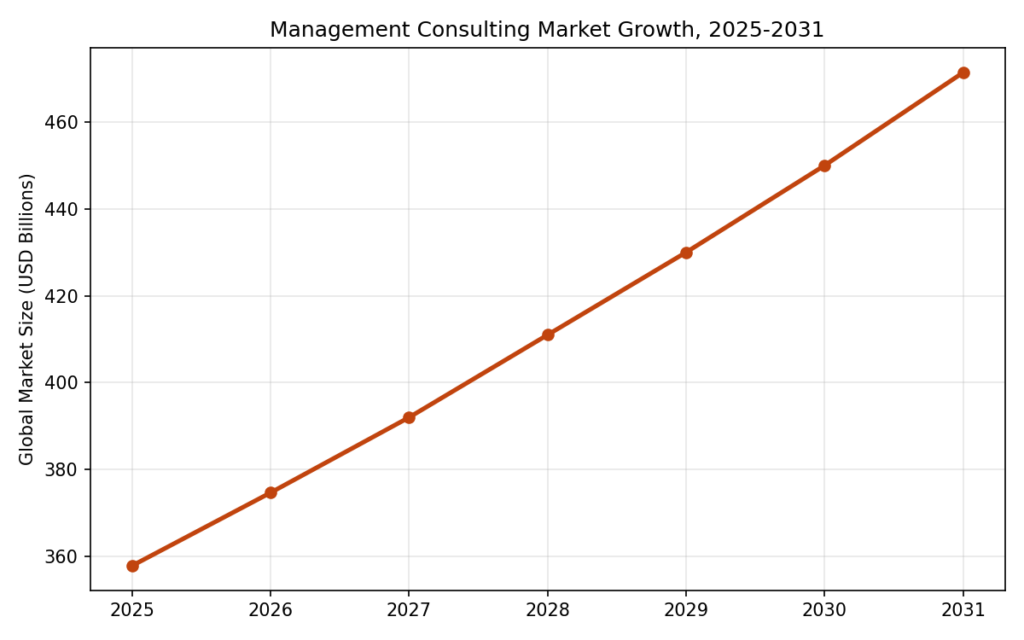
Consulting has never been a static profession. Every decade brings tools, client expectations, and delivery models that reshape how advisors add value. The global management consulting market surpassed $357 billion in 2025 and is projected to reach $471 billion by 2031, driven largely by demand for digital transformation, AI governance, and data strategy work. Yet amid this technological change, one truth remains constant: consulting success still hinges on the relationship between advisor and client.
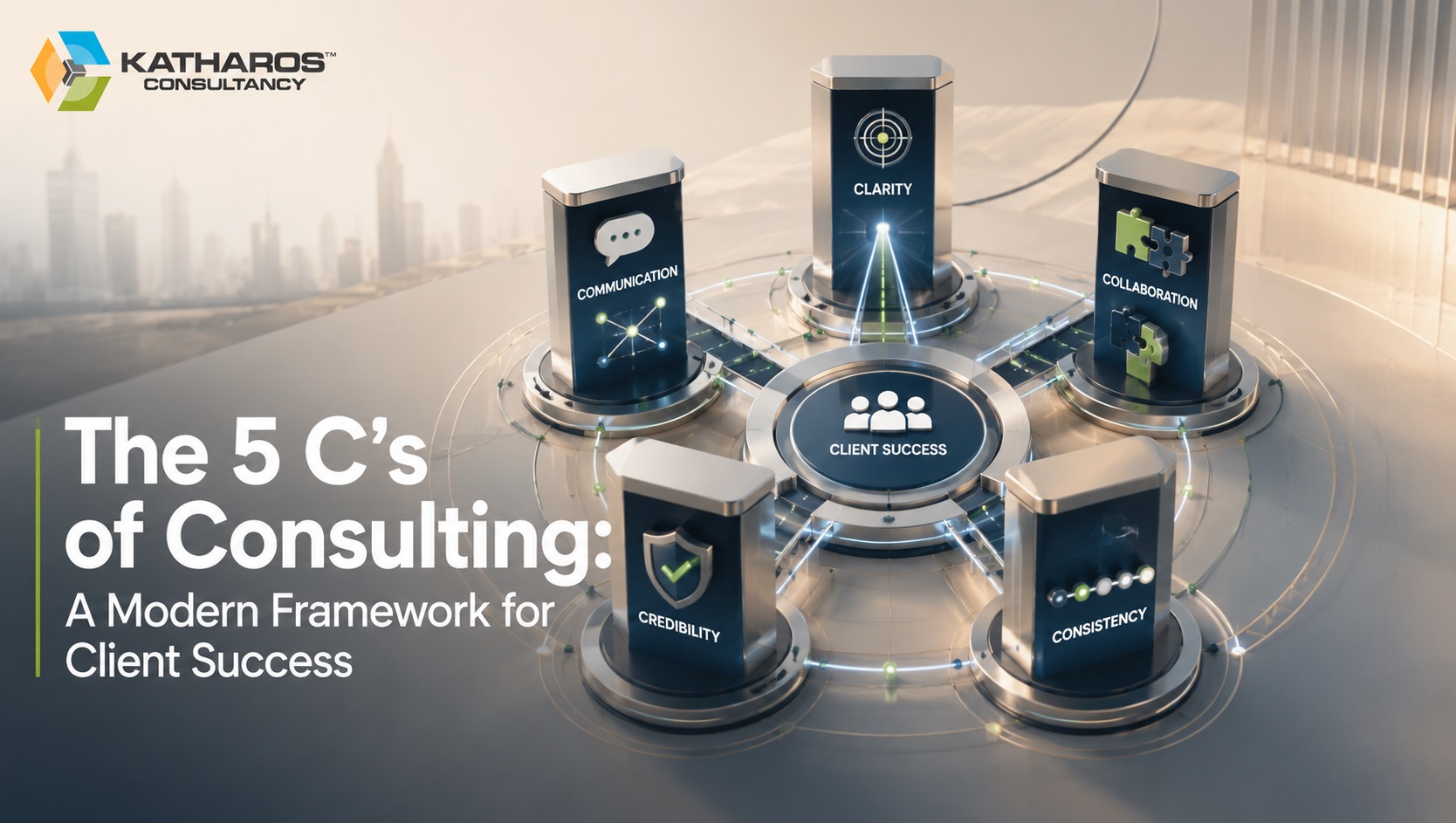
That is where the 5 Cs of consulting come in. This consulting framework distills decades of client engagement research into five interconnected pillars: Clarity, Communication, Collaboration, Credibility, and Consistency. Together, they form a practical consulting methodology that firms can apply regardless of industry, project size, or technology stack.
Why Firms Need a Modern Consulting Framework
Client expectations have shifted dramatically. Procurement teams now scrutinize consulting spend more closely, and buyers increasingly demand outcome-based pricing rather than open-ended retainers. A recent industry survey found that firms integrating structured feedback loops and CSAT tracking saw 20 to 30 percent higher client retention and 1.5 times greater cross-sell success compared with firms that skipped formal measurement.
This data points to an important shift. Technical expertise alone no longer wins repeat business. Clients want a client engagement model built around trust, transparency, and measurable results. The 5 Cs address that gap by turning soft skills into a repeatable, teachable system.
Consider three forces pushing firms toward this framework:
- Rising client sophistication. Executives now compare proposals across multiple vendors and demand proof of impact before signing.
- Remote and hybrid delivery. Roughly 65 percent of consulting projects were delivered remotely by 2023, up sharply from 40 percent in 2020, which strips away the informal trust-building that once happened in hallway conversations.
- AI-driven commoditization. As automation handles more routine analysis, the human elements of consulting become the true differentiator.
C1: Clarity
Clarity sits at the foundation of every successful engagement. Without a clearly defined scope, timeline, and success metric, projects drift, budgets balloon, and relationships sour.
Setting Clear Expectations Early
Strong consultants translate vague business problems into specific, measurable objectives before any work begins. This means:
- Documenting the exact deliverables, not just the general theme of the project
- Agreeing on success metrics that both sides can measure objectively
- Flagging assumptions and constraints in writing, so nothing gets lost in verbal exchanges
Clarity Reduces Scope Creep
When goals stay vague, scope creep follows almost automatically. Teams end up debating what “success” actually means halfway through a project. A written charter, revisited at each milestone, keeps everyone anchored to the original intent while still allowing room for justified adjustments.
C2: Communication
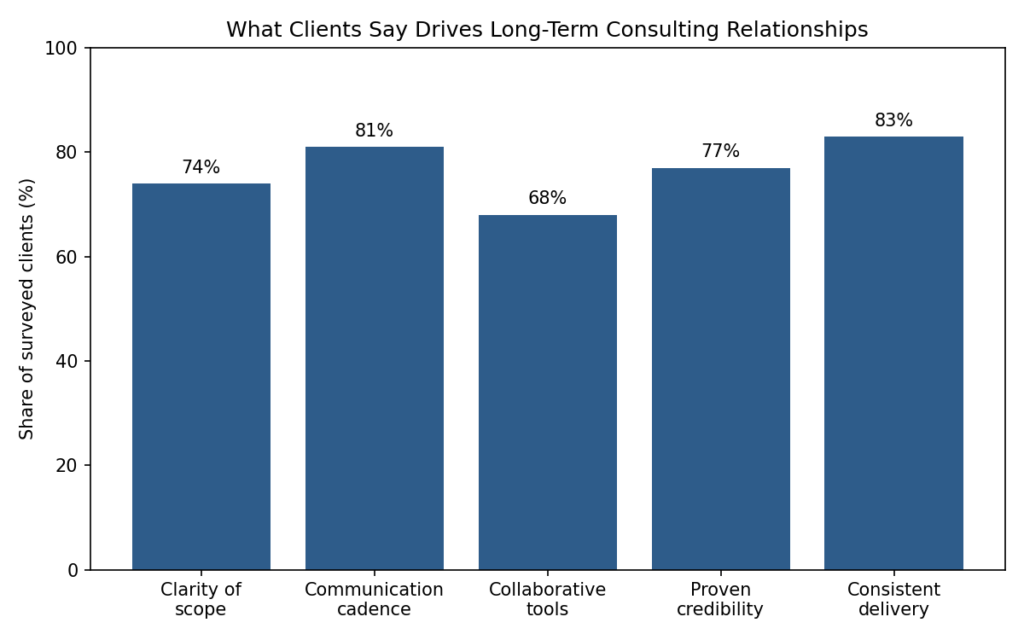
Communication ranked as the single strongest driver of long-term client relationships in the data behind the chart above, with 81 percent of surveyed clients citing consistent updates as essential. That statistic should reshape how firms structure their engagement cadence.
Building a Communication Rhythm
Effective consultants do not wait for scheduled check-ins to share bad news or early wins. Instead, they build a rhythm that includes:
- Weekly or biweekly status updates, even when progress feels incremental
- Proactive alerts the moment risks emerge, rather than burying them in a final report
- Plain-language summaries for executive stakeholders who lack technical background
Technology’s Role in Communication
Modern platforms like Slack, Asana, and Notion have replaced the static status report. Real-time dashboards now let clients track milestones themselves, reducing the anxiety that comes from radio silence between meetings. Firms that embed these tools into their client engagement model report fewer surprises and faster sign-offs.
C3: Collaboration
Consulting has moved away from the old model of consultants disappearing into a conference room and emerging weeks later with a finished deck. Clients now expect to co-create solutions alongside their advisors.
Embedding With Client Teams
The most effective engagements blend consultant expertise with internal institutional knowledge. Practical collaboration tactics include:
- Pairing consultants directly with client staff on working sessions, not just presentations
- Using shared workspaces where both sides edit the same documents in real time
- Running joint workshops that surface tacit knowledge only internal employees possess
Collaborative Tools Change the Game
Cloud-based project management and shared analytics platforms now let distributed teams work as if they sit in the same building. This matters because collaborative delivery, cited by 68 percent of clients in recent surveys, correlates with higher satisfaction and smoother handoffs at project close.
C4: Credibility
Credibility takes years to build and moments to lose. Clients hire consultants specifically because they lack in-house expertise, which means trust becomes the entire basis of the relationship.
Demonstrating Real Expertise
Credibility grows through demonstrated results, not claimed ones. Consultants earn it by:
- Sharing relevant case studies with quantified outcomes, rather than vague success stories
- Publishing original research or point-of-view content that showcases genuine expertise
- Admitting uncertainty honestly instead of overpromising outcomes to win approval
Independence Strengthens Trust
Clients increasingly value technology-neutral advisors over consultants perceived as tied to a specific vendor. Firms positioned as impartial, evidence-driven advisors are pulling ahead of competitors seen as pushing a particular product. This independence, backed by transparent methodology, forms the backbone of durable credibility.
C5: Consistency
The final pillar ties the other four together. Consistency topped the client survey data at 83 percent, making it the most cited factor behind long-term consulting relationships.
Delivering Reliable Outcomes
Consistency means clients get the same quality of thinking and responsiveness whether they are working with a senior partner or a junior analyst. Firms achieve this through:
- Standardized templates and quality checklists applied across every engagement
- Regular internal reviews that catch inconsistencies before clients notice them
- Clear escalation paths so problems get resolved quickly rather than lingering
Consistency Builds Long-Term Partnerships
A single great project earns a testimonial. Repeated excellence earns a multi-year partnership. Firms that institutionalize their consulting methodology, rather than relying on individual star performers, scale more predictably and retain clients through leadership changes and shifting priorities.
Bringing the Framework Together
None of these five pillars work in isolation. Clarity without communication leads to silent drift. Collaboration without credibility feels hollow. Consistency without any of the other four simply means reliably repeating the same mistakes. The real power of the 5 Cs of consulting lies in treating them as a connected system rather than a checklist.
Firms that adopt this consulting framework as a training tool, not a marketing slogan, onboard new consultants faster and standardize quality across offices. New hires gain a shared vocabulary for diagnosing a struggling engagement, whether the root cause lies in unclear scope, sporadic updates, siloed teams, or inconsistent execution.
Measuring the 5 Cs in Practice
A framework only earns its keep when firms can measure it. Turning the 5 Cs into a scorecard, rather than a poster on the wall, gives leadership a concrete way to track the health of engagement over time.
Building a Simple Scorecard
Many firms rate each active project against the five pillars quarterly. A workable approach includes:
- Scope-change frequency for Clarity; frequent revisions signal a weak initial charter
- Response time and update cadence for Communication, tracked through project software
- Joint working sessions versus one-way presentations for Collaboration
- Client-reported confidence scores for Credibility, gathered during quarterly reviews
- Variance in deliverable quality across team members for Consistency
Turning Scores Into Action
Low scores in one pillar rarely stay isolated for long. A drop in Communication often precedes a drop in Credibility, since silence breeds doubt. Firms that review these scores in leadership meetings, rather than filing them away, catch problems while they are still fixable.
Technology as an Accelerant, Not a Replacement
Artificial intelligence now touches nearly 78 percent of consulting service delivery in some form, from predictive analytics to automated reporting. But data and automation only amplify an already-working framework. A firm with weak communication habits will not fix client relationships by adding a chatbot. A firm with strong clarity and credibility, on the other hand, can use AI-powered dashboards to make its existing strengths even more visible to clients.
The lesson for modern advisory firms is straightforward. Build the human framework first, then let technology extend its reach.
Final Thoughts
The 5 Cs of consulting offer more than a memorable acronym. They provide a practical, research-backed client engagement model that firms can teach, measure, and refine over time. As competition intensifies and clients demand greater accountability, the firms that master Clarity, Communication, Collaboration, Credibility, and Consistency will distinguish themselves from those still relying on technical skills alone.
Consulting will continue to evolve with new technology, but the fundamentals of lasting client relationships remain stable. Firms that internalize this framework today position themselves for durable growth.
Sources: QuestionPro Client Satisfaction Survey research; Mordor Intelligence Management Consulting Services Market Report; ZipDo Management Consulting Services Industry Statistics; VantaInsights Consulting Industry Trends 2026; Management Consultancies Association (MCA) Member Survey 2026.