AI Governance for Small Businesses: A Practical 2026 Framework
by Sovina Vijaykumar
Small business owners no longer debate whether to use artificial intelligence. That question closed months ago. A 2026 U.S. Chamber of Commerce survey found that 89 percent of small businesses now use AI in some capacity, a jump from just 36 percent in 2023. The real question sitting in front of owners today is different: who is watching what these tools do, and who answers for it when something breaks?
That question is the entire idea behind AI governance. It is the set of rules, roles, and checks that decide how a company adopts, monitors, and corrects its use of AI. Large corporations have compliance departments to handle this. Small businesses usually have an owner, a laptop, and a growing list of subscriptions to tools nobody fully vetted.
Why the Gap Matters Right Now
The numbers paint a clear picture of a widening gap between adoption and control. Research from Grant Thornton’s 2026 AI Impact Survey found that 78 percent of executives lack strong confidence they could pass an independent AI governance audit within 90 days. Separate industry research puts comprehensive framework adoption at just 8 percent globally, and that figure falls to roughly 2 percent among small firms.
Meanwhile, momentum keeps building. A UK small-business study found that three-quarters of firms using AI tools operate with no house rules on what data staff can paste into a chatbot. Picture a bookkeeper pasting a supplier spreadsheet into a public AI tool to reformat it. That spreadsheet may hold bank details and contract terms, and now a third-party system holds them too.
| Metric | Figure | Source |
| Small businesses now using AI in some form | 89% | U.S. Chamber of Commerce, 2026 |
| Small firms with a comprehensive AI governance framework | ~2% | Industry AI governance research, 2026 |
| Executives lacking confidence in passing an AI audit within 90 days | 78% | Grant Thornton AI Impact Survey, 2026 |
| Small businesses using AI with no formal prompting strategy | 77% | Aufsite Research, 2026 |
| Revenue growth reported by fully integrated AI adopters vs. early pilots | 58% vs. 15% | Grant Thornton AI Impact Survey, 2026 |
The pattern across every survey stays consistent. Adoption keeps sprinting ahead. Oversight keeps crawling behind.
What Responsible AI Actually Looks Like for a Small Team
Responsible AI for business does not require a legal department or a six-figure compliance budget. It requires a short list of deliberate habits, applied consistently, and reviewed on a schedule the owner actually keeps.
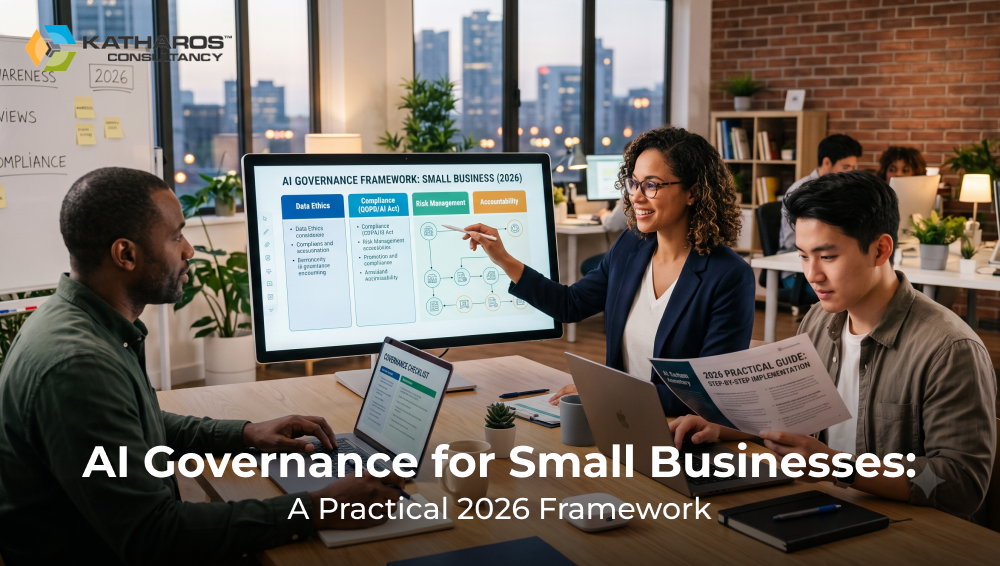
A workable AI governance framework for a small company rests on five pillars:
- A clear inventory. List every AI tool in use, who uses it, and what data touches it.
- A short written policy. One page beats no page, and clarity beats length.
- A named owner. Someone specific answers for AI decisions, even in a five-person shop.
- Risk tiering. Not every tool carries equal weight, so treat them differently.
- A review cadence. Quarterly check-ins catch problems before they turn expensive.
Each pillar supports the next one. Skip the inventory, and the policy has nothing real to govern. Skip the named owner, and nobody enforces the policy once the initial excitement fades.
Step One: Build the Inventory Before Anything Else
Most owners underestimate how many AI tools already run inside daily operations. Marketing may copy through a generative writer. Finance may use an AI-powered bookkeeping assistant. Customer service may lean on a chatbot plugin bundled inside a helpdesk platform nobody reviewed carefully.
Spend one afternoon walking through every department and asking a simple question: does this tool touch customer data, financial records, or contracts? Write the answer down. This document becomes the backbone of every governance decision that follows, and it costs nothing but time.
Step Two: Write a Policy That Fits on One Page
An AI policy for a small business fails the moment it becomes a document nobody reads. Keep it short, keep it specific, and anchor it to real scenarios your staff already faces.
A strong one-page policy answers four questions plainly:
- Which tools may staff use for customer or financial data, and which tools are off-limits?
- What information must never enter a public AI tool, such as Social Security numbers or contract terms?
- Who approves a new AI tool before someone downloads it onto a company device?
- What happens when an AI-generated output turns out wrong, and who corrects it?
Store the policy somewhere staff actually check, such as an onboarding folder or a shared drive, rather than burying it inside a handbook nobody opens twice.
Step Three: Assign Real Ownership
Governance collapses without a named owner, and vague ownership works just as poorly as no ownership at all. In a ten-person company, the owner might handle this role personally for thirty minutes each month. In a fifty-person company, an operations manager might take the assignment as a defined part of a broader compliance role.
The owner’s job stays narrow but firm: track new tool requests, flag risky use cases, and keep the written policy current as tools change. This single role often separates companies that pass an informal audit from companies that cannot explain how a customer complaint traces back to an automated decision.
Step Four: Tier Your Risk Instead of Treating Every Tool the Same
Not every AI use case deserves the same scrutiny. A grammar checker inside a word processor carries far less risk than an automated tool that screens job applicants or approves loan terms.
Sort every tool from the inventory into three simple tiers:
- Low risk: grammar and formatting tools, internal brainstorming assistants, scheduling helpers.
- Medium risk: customer-facing chatbots, marketing content generators, sales forecasting tools.
- High risk: hiring screens, credit decisions, medical or legal guidance, anything touching regulated data.
High-risk tools deserve human review of every output before a decision reaches a customer or employee. Low-risk tools need only periodic spot checks. This tiering approach keeps governance proportional instead of burying an owner in paperwork for tools that pose almost no real threat.
Step Five: Review on a Fixed Schedule
A framework written once and never revisited turns stale within months, given how quickly vendors update their tools. Set a recurring quarterly review, and treat it with the same seriousness as a tax deadline.
During each review, update the tool inventory, re-check risk tiers for anything new, and confirm the written policy still matches current practice. Ask staff directly whether any new tool has crept into daily use without formal approval. Informal adoption happens constantly, and a scheduled review remains the surest way to catch it early.
Vendor Contracts Deserve a Second Look

Small businesses often sign up for an AI tool through a simple click-through agreement, without reading how the vendor trains its models. Before adopting any tool that touches customer data, ask the vendor three direct questions: Does customer data train the underlying model? How long does the vendor retain that data? And can the business delete its data on request?
A vendor that cannot answer clearly deserves caution rather than a signature.
Training Closes the Confidence Gap
Only 23 percent of small businesses using AI have given staff any formal training on these tools, according to recent research. That gap explains much of the inconsistent output owners complain about. A short internal training session, even one lasting an hour, teaches staff what belongs in a prompt, what never belongs in a prompt, and how to flag a questionable AI output to the named owner.
Training does not need outside consultants. A written guide paired with two or three real examples from the business often does more good than a generic course built for a different industry entirely.
The Bottom Line for 2026
The businesses pulling ahead this year share one trait: they treat governance as an ordinary part of running a company rather than a burden layered on top of it. An AI governance framework built from five clear pillars- an inventory, a short policy, a named owner, tiered risk, and a fixed review schedule- turns AI from an unmanaged risk into a genuine advantage.
Small businesses that build this habit now will not scramble later, when a regulator, an insurer, or a customer asks the one question every company should already be able to answer: who is watching the AI, and what happens when it gets something wrong?