Strategic Cost Optimization Without Cutting Growth
by Sovina Vijaykumar
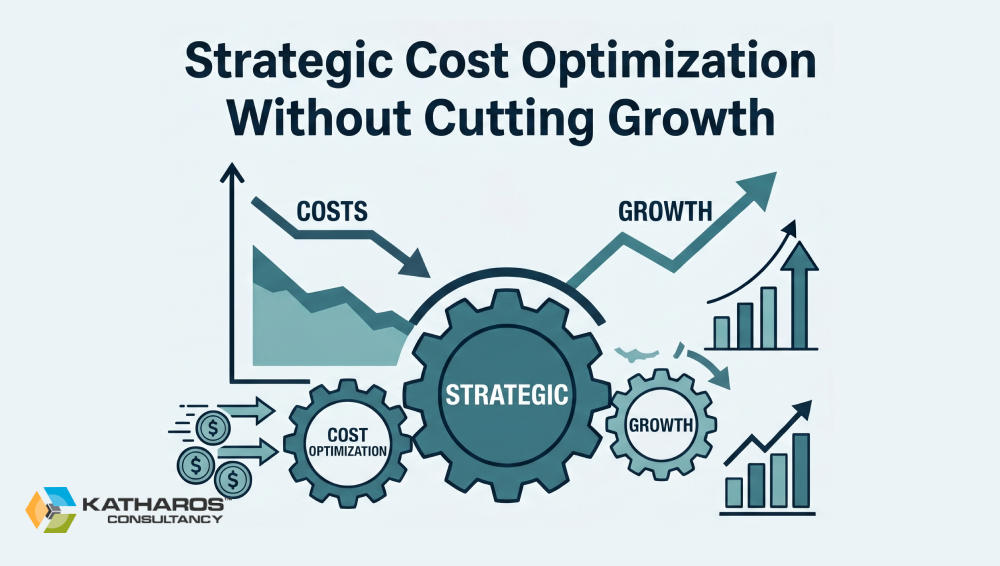
A moment leaders dread: the CFO says, “Cut costs.” What follows is predictable and often harmful: layoffs, vendor cuts, hiring freezes, and delayed tech. The company gets leaner on paper. It also slows down, becomes less competitive, and, more often than not, becomes less profitable within 12 to 18 months.
This is the cost-cutting trap. Confusing it with true optimization is costly.
Companies that endure downturns do not cut less; they cut smarter. They make surgical decisions about where money is doing real work and where it is just circulating out of habit. This article shows how firms build cost intelligence with tech, design, and a framework that protects growth and cuts waste.
The False Binary That Is Costing You
When executives are asked about cost optimization, most describe cost reduction. Cut vendors. Reduce headcount. Freeze discretionary spend. Delay capital projects. These actions produce a number that looks better on a quarterly report. They rarely produce a business that is positioned to grow.
Research by Bain & Company on sustained value creators shows a consistent pattern. These companies invest at inflection points rather than retreat from them. They gain share in downturns by knowing which costs protect the future and which are waste.
Cost optimization redirects spend from low to high value without harming growth.
A Framework That Changes the Conversation
Leaders should stop treating costs as a single bucket and map every dollar to three tiers.
Foundational costs keep the business running and compliant. Infrastructure, data security, regulatory compliance, and core retention programs are non-negotiable. Cutting here creates a compounding risk that eventually costs far more than the savings generated.
Growth-enabling costs are the investments that directly expand your revenue capacity or competitive advantage. Product development, sales infrastructure, customer success, and R&D deserve aggressive protection, even during a margin crunch. Cutting growth-enabling costs to improve short-term EBITDA is equivalent to burning seed corn. You feel the warmth immediately. You feel the famine later.
Inertia costs are the real target. These are expenses the organization carries not because they drive value, but because they have always been there. Legacy software subscriptions nobody actively uses. Redundant vendor relationships that multiplied through acquisitions. Team structures built for a market reality that no longer exists. Manual processes that automation made obsolete two years ago, but nobody got around to changing them.
Most firms find that inertia costs are 15 to 30 percent of total spend. That capital is not working. It is just somewhere comfortable.
Technology as the Intelligence Layer
Modern cost optimization is not an annual exercise. It is a continuous process, and the companies doing it best treat technology as the engine that enables real-time intelligence.
Cloud spend is the clearest example. High-growth SaaS teams find that 30-40% of their infrastructure spend is unused. Amazon Web Services Savings Plans, Google Cloud discounts, and tools like CloudZero and Spot.io reveal true costs. A Series B fintech cut infra costs 38 percent in six months while tripling users.
Artificial intelligence is also reshaping vendor management and procurement intelligence. Platforms like Vendr and Zip now use machine learning to benchmark software contract pricing against anonymized market data, surfacing overpayment in real time. A company paying above-market rates for its CRM or security stack no longer needs to wait for a renewal cycle to discover the gap; it can act on that intelligence continuously.
Automation deserves a more nuanced treatment than it usually gets in efficiency conversations. Automating genuinely repetitive, rules-based processes, such as invoice processing, data reconciliation, and compliance reporting, delivers durable savings with minimal operational risk. Automating a process that still requires human judgment creates fragility. The discipline is in distinguishing between the two before committing capital to implementation.
The Real Math Behind Headcount Decisions
Layoffs are the default lever in most cost reduction playbooks. They are also, in most cases, the most expensive option available.
Gallup’s research on employee engagement estimates that disengagement costs organizations roughly thirty-four percent of a disengaged employee’s annual salary in lost productivity. The cost of a layoff, severance, legal exposure, outplacement, the erosion of institutional knowledge, and the cultural damage that follows typically runs 1.5 to 2 times the departing employee’s annual salary. When growth resumes and the company refills the position, it adds another layer of cost by rehiring and retraining for the role.
The math rarely supports the business case; it appears to be on the surface.
The companies that consistently reduce costs without layoffs do it through internal redeployment, deliberate organizational design, and honest assessment of role leverage. A high-leverage role, one where the output directly drives revenue, product quality, or customer retention, has a value that does not show up neatly on a cost-per-head analysis. A low-leverage role, one that exists primarily to maintain a process that should not exist, is a cost worth addressing. Still, the right response is to eliminate the process, not reduce headcount.
Contractor and fractional talent models give growth-phase companies a structural advantage here. Building a flexible capacity model, where core strategic functions stay in-house and variable execution capacity scales with demand, allows businesses to reduce costs without layoffs while retaining the flexibility to accelerate when market conditions shift.
Procurement in the Age of AI

The negotiation leverage between buyers and software vendors has fundamentally shifted over the past five years, and most procurement teams have not kept pace.
AI-powered benchmarking tools have enabled walking into any renewal negotiation with real market data. If your organization pays above the median for a platform used by companies of comparable size and contract structure, you can know that before the first call. That changes everything about how the conversation starts.
Multi-year commitments make sense when you deeply integrate a vendor’s product into your operations and face high switching costs. Usage-based pricing makes sense when your consumption is variable, and the vendor’s market position gives you optionality. The discipline is in knowing which situation you are in, and most organizations default to multi-year commitments out of inertia rather than strategic logic.
Vendor consolidation offers another underutilized lever. Stack sprawl, the accumulation of dozens of point solutions acquired through departmental purchasing decisions, creates not just cost redundancy but integration overhead that taxes engineering capacity. Moving toward API-first platforms with broad surface area reduces licensing costs, simplifies integration, and creates negotiating leverage through consolidation.
Outcome-based SLAs represent the most advanced form of procurement intelligence. Paying for results rather than seats or hours aligns vendor incentives with business outcomes and creates a natural pressure toward efficiency in the vendor relationship.
Where Most Cost Waste Actually Lives
Finance and Engineering teams operate in separate cognitive universes in most organizations. Finance tracks spend in cost-center categories. Engineering tracks spend on infrastructure and tooling decisions. Nobody owns the interface between them.
This is where most cost waste lives.
When Engineering makes a build-versus-buy decision, it rarely incorporates full-cost accounting. When Finance reviews a cloud bill, it rarely has the technical context to understand what each line item represents or whether it is necessary. The result is that cost conversations happen at annual budget cycles, decisions get made with incomplete information, and the continuous optimization that would produce real savings never actually runs.
The solution is not more meetings. It is shared infrastructure. Cost attribution, tagging infrastructure, and operational spend to specific product lines, features, or customer segments gives both teams a common language. When an engineering team can see that a legacy feature costs four hundred thousand dollars a year to run and generates less than fifty thousand dollars in attributable revenue, the decision to sunset it becomes obvious. Without that visibility, it stays on the books indefinitely.
OKR structures that reward teams for efficiency, not just output, close the last gap. Organizations that measure only velocity and output create structural incentives to spend. Organizations that measure unit economics alongside growth metrics build cost intelligence into every team’s decision-making process.
The 90-Day Roadmap
Implementing a genuine cost-optimization strategy does not require a multi-year transformation program. The first wave of material impact happens in ninety days.
In the first thirty days, the priority is audit and classification. Map every significant cost item to the three-tier framework: Foundational, Growth-Enabling, or Inertia. Do not skip this step in favor of jumping to solutions. The classification process forces conversations that surface assumptions that have been running on autopilot for years.
In days thirty-one through sixty, direct attention to the highest-value inertia costs and initiate vendor renegotiations on the top five to ten contracts by spend. Use market benchmarking data where available. Set up cost attribution tagging in your cloud environment. Begin building the Finance-Engineering shared dashboard.
In days sixty-one through ninety, redirect the freed capital. This is the step that separates cost optimization from cost cutting, the explicit reinvestment of savings into the highest-return growth levers. The burn multiple, cost-to-revenue ratio, and CAC payback period should serve as your primary tracking metrics.
The Moat You Are Not Building
Every dollar of inertia cost that a business eliminates and redirects toward growth-enabling activity produces a compound effect that goes beyond the financial statement. It builds organizational muscle, the habit of continuous allocation discipline, the cultural expectation that every dollar earns its place, and the operational clarity that enables faster, better decisions.
The companies that dominate their markets five years from now are not the ones that grew the fastest last year. They are the ones that built the most efficient growth path, the ones that treated cost intelligence as a competitive capability rather than a quarterly exercise.
A rigorous cost-optimization strategy, executed with technology, organizational alignment, and the discipline to protect growth-enabling investment, does not make a business smaller. It makes it faster, sharper, and harder to compete against.
The question is not whether you can afford to do this. It is whether you can afford to keep doing the alternative.